Conservative, Or?
Analysis by Ben Everidge for Thomas
An Assessment of MAGA, Continuity, and Departure …
(The author earned a graduate degree in American government from Georgetown University, where he was also named a University Fellow after serving for a decade on professional and campaign staff in the United States Senate and U.S. House of Representatives.)
In political science, movements are rarely born from nothing. They emerge from older traditions, reshape them, and often challenge them from within.
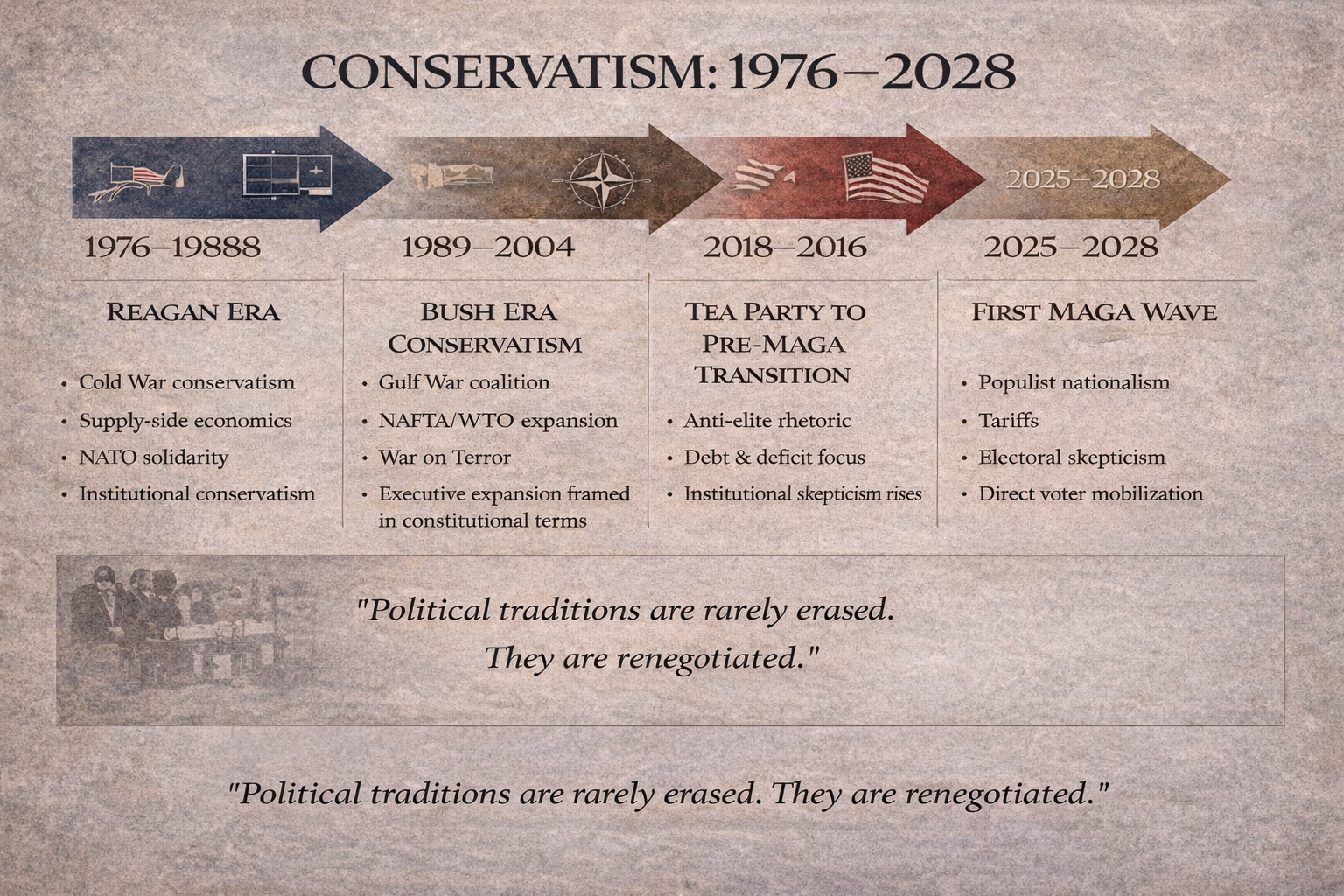
The modern MAGA movement associated with Donald Trump is often described as “conservative.” But compared to late 20th-century American conservatism, roughly the Reagan-Bush era, it represents both continuity and rupture.
To understand where the Republican Party is today, we must understand where it was.
What Late 20th-Century Conservatism Believed
From the 1070s through the early 2000s, American conservatism was built on a relatively stable ideological tripod:
1. Limited Government & Constitutional Restraint
Conservatives emphasized:
Federalism.
Separation of powers.
Judicial restraint.
Respect for institutional continuity.
Even when expanding executive power, as during the War on Terror, leaders framed those actions in constitutional and statutory terms.
2. Free Markets & Global Trade
Reagan-era and post-Reagan conservatives broadly supported:
Free trade agreements (NAFTA, WTO).
Deregulation.
Market globalization.
Low taxation as a growth policy.
Free enterprise was seen as a moral and strategic advantage over communism.
3. Strong Alliances & Anti-Authoritarian Foreign Policy
Cold War conservatism emphasized:
NATO cohesion.
Support for democratic allies.
Skepticism toward Russia.
Opposition to authoritarian expansion.
American leadership abroad was considered stabilizing rather than disruptive.
What MAGA Represents
MAGA retains some conservative language - particularly around deregulation, border enforcement, and judicial appointments – but diverges in key areas.
Institutional Skepticism
MAGA rhetoric is marked by:
Deep distrust of federal agencies.
Confrontation with intelligence services.
Direct attacks on electoral processes.
Willingness to challenge or reinterpret constitutional norms.
Where traditional conservatism sought to “limit” institutions, MAGA often seeks to discredit or bypass them.
Economic Nationalism Over Free Trade
Unlike Reagan-era globalism, MAGA emphasizes:
Tariffs.
Industrial nationalism.
Strategic trade leverage.
Skepticism of multinational agreements.
This is closer to 19th-century protectionism than 1990s market liberalism.
Transactional Foreign Policy
Traditional conservatives prioritized alliance stability. MAGA frequently adopts:
Transactional rhetoric toward NATO.
Threat-based diplomacy toward allies.
Public bargaining over defense commitments.
Supporters argue this increases leverage. Critics argue it destabilizes alliances.
Where the Two Traditions Overlap
Despite differences, continuity exists:
Strong military investment.
Cultural conservatism.
Emphasis on national sovereignty.
Judicial appointments rooted in originalism.
MAGA did not reject conservatism entirely. It reweighted its priorities.
Style vs. Substance
A major difference lies in political style.
Late 20th-century conservatism relied heavily on:
Coalition-building.
Institutional messaging.
Elite mediation (think tanks, policy journals, party leadership).
MAGA thrives on:
Direct voter mobilization.
Media confrontation.
Personality-driven leadership.
Digital amplification.
The change is not only ideological. It is structural and communicative:
Emphasis on national sovereignty
Judicial appointments rooted in originalism
MAGA did not reject conservatism entirely. It re-weighted its priorities.
What a 1990s Conservative Might Question
An orthodox conservative from 1995 might ask:
Why weaken NATO publicly?
Why pursue tariffs as primary economic leverage?
Why elevate executive authority rhetorically while criticizing federal overreach?
Why frame electoral defeat as systemic corruption rather than persuasion failure?
These questions are not partisan critiques. They are internal ideological ones.
What MAGA Supporters Would Counter
Supporters of MAGA would argue:
Institutions had already failed before being criticized.
Global trade hollowed out the domestic industry.
Alliances became one-sided burdens.
Elites were unresponsive to working-class concerns.
Executive force is necessary to disrupt entrenched bureaucracies.
In this sense, MAGA is not anti-conservative. MAGA is what is rightly called a revisionist conservative.
The Deeper Question: What Is Conservatism Now?
Political movements evolve when voter coalitions shift.
Late 20th-century conservatism was:
Elite-mediated.
Cold War-oriented.
Market-globalist.
Institutionally respectful.
MAGA conservatism is:
Populist.
Nationalist.
Economically protectionist.
Institutionally confrontational.
The question facing American politics is not whether one is “right” or “wrong,” but whether they are philosophically compatible in the long term.
Why This Matters for 2026 and 2028
As the share of independent voters grows nationally, the definition of “conservative” may matter less than perceptions of governance stability.
Independent voters tend to favor:
Institutional predictability.
Economic pragmatism.
Alliance reliability.
Constitutional clarity.
If conservatism continues to evolve under MAGA influence, it may either consolidate into a stable governing doctrine or fragment between populist and institutional wings.
History shows that parties that fail to reconcile internal philosophies often lose national coalitions.
A Phase of Reinterpretation
From a political science perspective, MAGA is not the end of conservatism.
It is a phase of reinterpretation.
Whether it becomes the durable definition of American conservatism – or a populist interlude within a longer institutional tradition – will depend on:
Electoral performance.
Governing outcomes.
Institutional durability.
Independent voter response.
Political traditions are rarely erased. They are renegotiated. And that negotiation is still underway.