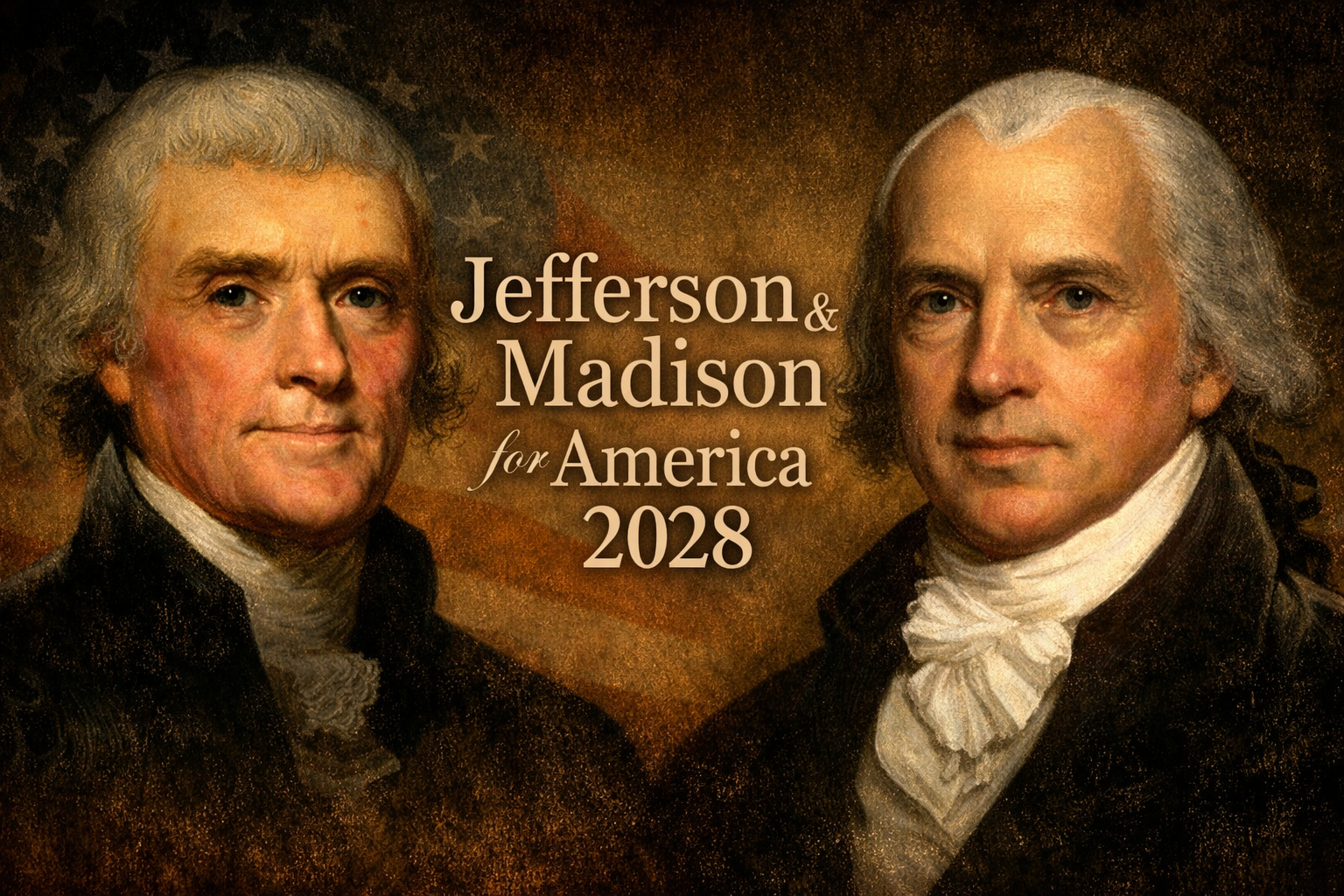
So, what are we? What is this?
Jefferson & Madison for America 2028 is not like another brand or another newsletter.
It functions as a constitutional lens inside Thomas that does three things simultaneously:
Legitimizes the independent path historically.
Educates without campaigning (much like our sister initiative, The Independent Quill on Substack.”
Prepares elite, media, and civic audiences to see an independent presidency as restorative, not disruptive.
At its core, this feature is a hypothetical constitutional dialogue between the architects of the Republic and the problems of modern governance.
It is not:
Cosplay history.
Nostalgia.
Performative founding father rhetoric.
Or a proxy for partisan argument.
It is:
A serious institutional commentary.
A framing tool for independence.
A legitimacy engine for reform.
Think of it as: “Founders as governance critics, not mascots.”
Where It Lives
Jefferson & Madison for America 2028 is a standing feature vertical inside Thomas, alongside but not replacing our:
Thomas’s essays.
Video Vignettes.
Independent Quill cross-posts.
In other words, it is a recurring constitutional briefing, not a serial story. It is a series of essays, dialogues, and commentaries examining modern American governance through the constitutional principles articulated by Thomas Jefferson and James Madison – applied, not idolized.
The Core Structure
Every piece in this series will endeavor to use contrast, not monologue.
Jefferson was focused on liberty, decentralization, skepticism of concentrated power, and generational renewal.
Madison was focused on institutional design, faction control, stability, and constitutional restraint.
This gives you access to built-in intellectual balance:
Idealism vs. structure.
Energy vs. discipline.
Reform vs. durability.
That balance, we hope you will find, mirrors the Prosperity Republic and Democracy Defense framework we advocate, especially as written in The Independent Quill.
Our Standard Formats
To keep this a disciplined process for you, we will use four repeating formats:
1. The Jefferson & Madison Brief
The brief will be relatively short – approximately 800 to 1,000 words. It will highlight:
One modern governance problem.
Jefferson’s concern.
Madison’s concern.
Where both would likely agree today.
What constitutional self-government requires now.
Examples include:
Executive overreach.
Shutdown threats and politics.
Emergency powers.
Party capture of institutions.
2. Then & Now
This feature will be medium-length, approximately 1,200 to 1,500 words. It will focus on:
A Founding-era debate or concern.
The modern analog.
How incentives have drifted.
Why independence was built into the system.
Our objective here is to reinforce why an independent president is not radical but, by design, expected.
3. Letters Across Time
This element is designed to be creative but grounded. It will:
Have Jefferson “write” to Madison about a modern issue.
Madison will “reply” with institutional caution.
It will end with a sober takeaway.
This feature will work well for:
Social amplification.
Video voiceovers.
Cross-posting excerpts.
4. The Constitutional Test
Each issue raised here asks: “Would this practice pass a Jefferson – Madison test of republican self-government?”
Applied to:
Shutdowns.
Governing by executive order.
Politicized courts.
Emergency declarations.
Party loyalty over constitutional duty.
Put simply, this becomes for you a quiet accountability framework – not aimed at people, but at practices.
How It Advances The 2028 Election
Jefferson & Madison for America advances the 2028 election by:
1. Normalizing the Independent Executive
Jefferson & Madison remind readers that:
Parties were suspect from the beginning.
Independence was a feature, not a flaw.
Loyalty to the Constitution was primary.
This should help re-frame for you that independence is orthodox, not fringe.
2. Reinforcing Democracy Defense Without Preaching
Instead of saying, “Democracy is under threat,” let us show you instead:
How institutional shortcuts violate original design.
Why was the restraint intentional?
Why crisis governance was feared.
We hope you will find this to be far more persuasive as a serious reader.
3. Bridging to the Prosperity Republic Naturally
Jefferson & Madison:
Understood debt as moral and political.
Feared instability.
Valued predictable rules.
This should therefore allow you to:
Tie economic stability to constitutional design.
See that prosperity requires governance discipline.
Put simply, no leap will be required.
The Tone & Governance Rules You Can Expect
To protect the integrity of this feature from Thomas, we will:
Never use Jefferson & Madison to endorse a person.
Never use modern party labels.
Never mock or caricature.
Never imply certainty where history is ambiguous.
We believe the power of this feature is restrained.
We would feel we have accomplished our mission if law clerks read us, editors quote us, political donors and activists respect us, and institutions do not dismiss us.
Our Bottom Line
Jefferson & Madison for America 2028 is designed to act for you as: The constitutional conscience of the independent path.
It doesn’t shout, and it doesn’t attempt to persuade directly.
Instead, we are structured to make the alternative feel anchored, serious, and overdue.
We hope you will join in that journey – join in that discussion – that should be America 2028.