The Publius Debates @ 250
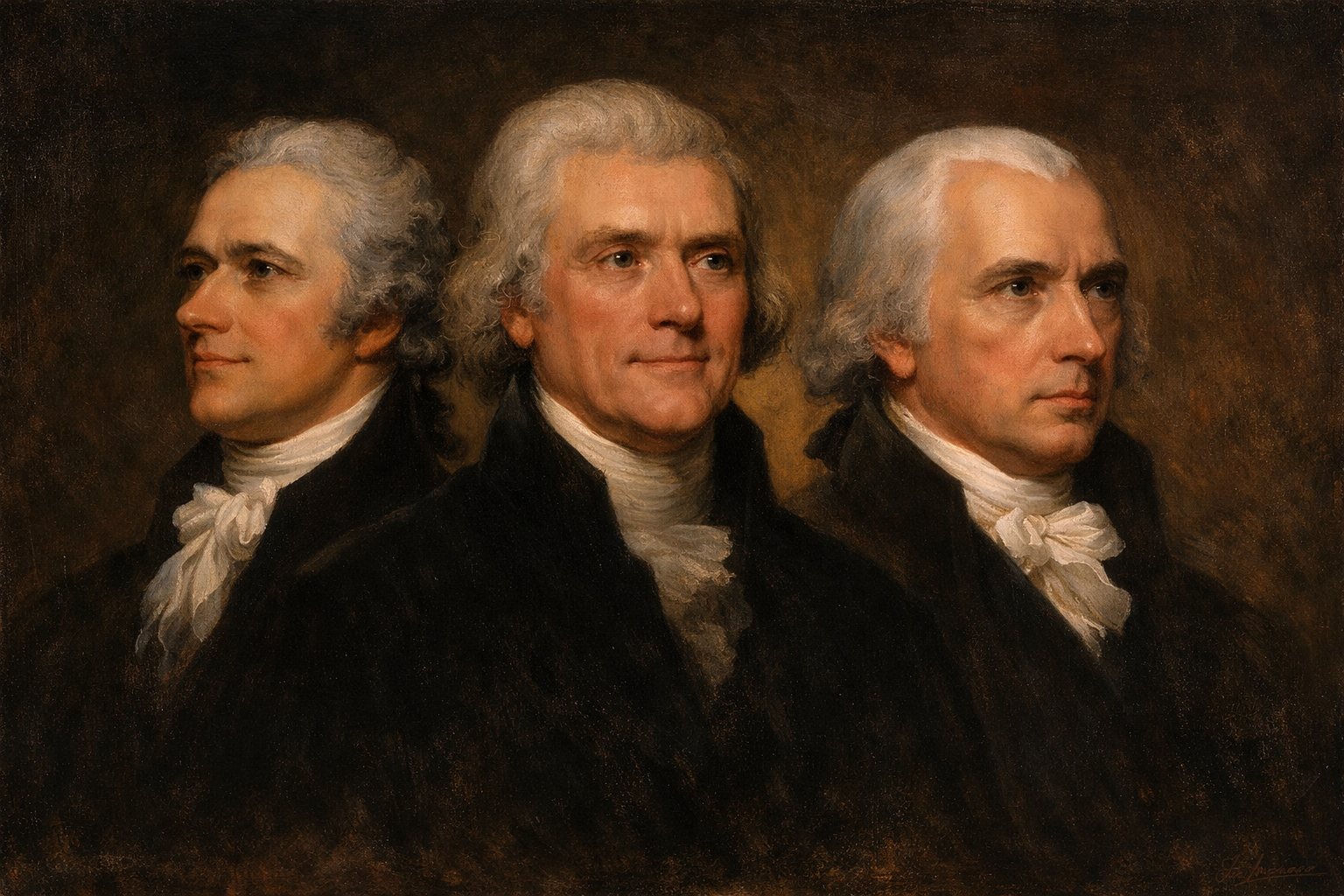
Image: Thomas generated with AI
March 13, 2026
Inspired dramatic dialogue…
Each Friday, starting with the first topic below, Thomas will present The Publius Debates @ 250, a short dramatic dialogue inspired by the spirit of the American founding.
Named for James Madison, who wrote a number of the Federalist Papers under the pen name Publius, this feature imagines Madison in conversation with Thomas Jefferson, our publication’s namesake, about the constitutional, political, and civic challenges facing the modern republic.
Their exchanges are not meant as historical reenactments but as reflections rooted in the principles these founders helped establish. From time to time, Alexander Hamilton’s energetic voice will join the discussion to sharpen the debate and add a third perspective.
The goal is simple: to revive the tradition of serious civic argument – thoughtful disagreement about and advocacy for how the American republic should endure.
Be sure to add your own two cents to the debate in the comment section below!
If you want to know more about the topics covered in The Federalist Papers, read them here
March 13, 2026
The First Debate
The first debate in this series, celebrating America’s 250th birthday, focuses on political chaos:
Jefferson
Gentlemen, the republic appears today overwhelmed by political spectacle. Citizens are encouraged to choose sides before they have chosen facts.
Hamilton
Public life, Thomas, has always contained theater. The danger is not spectacle itself, but whether capable leadership emerges from it.
Madison
The greater danger, Alexander, is an unchecked faction. The Constitution was designed precisely because political passions can overwhelm reason.
Jefferson
Then perhaps the question is not whether politics is loud but whether citizens remain thoughtful.
Hamilton
A nation cannot be governed by noise alone. At some point, leadership must impose order upon debate.
Madison
Order, yes. But always within constitutional limits, gentlemen.
March 20, 2026
Debate II: Power and Process
The American republic again finds itself confronting an old tension in a modern form: When urgency rises, does process yield or endure?
In moments of war, economic pressure, or national insecurity, presidents often act first and justify later. Congress deliberates. The courts interpret. The public reacts.
But beneath the noise lies a deeper constitutional question: Is the strength of the republic measured by the speed of its decisions or the discipline of its process?
In this second Publius Debates @ 250, Thomas Jefferson, James Madison, and Alexander Hamilton return to consider whether power can remain legitimate when it moves faster than the constitutional order designed to contain it.
Jefferson
Sir, I confess no small concern at the spirit of the age.
There is among us an increasing tolerance – if not an appetite – for power exercised without patience. Decisions once deliberated are now declared. Authority once shared is now assumed.
We are told that necessity demands it.
But necessity has ever been the argument of those who would prefer expedience to liberty.
If the laws may be set aside in moments of urgency, then it is precisely in those moments that liberty is most endangered, for it is when fear arises that restraint is most needed, not least.
A republic cannot endure if its principles are observed only in times of calm.
Madison
Mr. Jefferson raises a concern not unfamiliar to me.
The Constitution was not designed for moments of ease. It was constructed precisely for moments of strain when ambition, fear, and necessity would tempt men to exceed their bounds.
We divided power not to slow government for its own sake, but to prevent its consolidation.
If one branch may act without the participation of the others, particularly in matters of war or economic force, then the balance we so carefully constructed is not merely weakened; it is bypassed.
Yet I will concede this: the Constitution does not render government incapable of action. It requires only that action be shared, justified, and accountable.
The question before us, then, is not whether the government may act swiftly, but whether it may act alone.
Hamilton
Gentlemen, I find your arguments admirable, but perhaps incomplete.
Government must not only be restrained – it must be effective.
A nation that cannot act decisively in moments of danger invites not liberty, but vulnerability.
The executive, by design, was vested with energy. Not to replace the legislature, but to ensure that the nation is not paralyzed while deliberation unfolds.
There are circumstances – war among them – where delay is itself a decision, and often a costly one.
The danger, therefore, is not merely in the accumulation of power, but in the failure to use it when required.
The true question is not whether the executive acts – but whether, after acting, it remains accountable to the constitutional order.
A Modern Voice
Gentlemen, your arguments endure, but so too do your complications.
The modern world moves at a pace you could scarcely have imagined 250 years ago.
Conflicts unfold not over months, but in hours. Economic decisions ripple globally in seconds.
Public expectation demands an immediate response. And yet, your framework still governs us.
Today, Americans are divided not only over outcomes but over the process itself.
Some argue that decisive leadership requires bypassing delay.
Others argue that any departure from constitutional procedure is a threat to the republic.
So, I ask you plainly: If speed and structure now collide, which must yield?
Jefferson
If one must yield, it must not be the Constitution.
For once, its structure is bent to accommodate speed; it will not easily return to form.
Liberty, once compromised for convenience, is rarely restored without cost.
Madison
The Constitution need not yield. It must be engaged.
If the pace of modern life strains our processes, then our institutions must rise to meet that pace without abandoning their roles.
Congress must act when action is required.
The executive must consult when consultation is possible.
The failure is not in the structure, but in its neglect.
Hamilton
I would submit a reconciliation.
Speed and structure need not be enemies.
Let the executive act when necessity demands, but let that action be followed by prompt accountability.
Let Congress authorize where it must, review where it should, and restrain where it is necessary.
The republic is not endangered by energy. It is endangered when energy escapes oversight.
The Thomas Take
The founders do not resolve the tension. They clarify it.
A republic must be capable of action. But it must also be governed by rules that outlast the moment.
When power moves faster than process, the risk is not only error. It is precedent. And precedent, once established, becomes practice.
The issue of our time to consider, therefore, becomes this:
As Americans confront new crises – foreign and domestic – the question is not whether the nation will act. It will. The question is whether it will act within the constitutional order that defines it.
March 27, 2026
Debate III: War Powers & the Consent of the Governed
War has always tested republics.
Not simply on the battlefield, but in their commitment to constitutional order.
In moments of danger, the pressure to act swiftly is immense. Decisions must be made. Enemies must be confronted. Alliances must be honored.
Yet the American system was designed with a deliberate tension: The power to wage war is divided.
In this third Publius Debate, Thomas Jefferson, James Madison, and Alexander Hamilton consider a question that remains urgent today. Can a republic go to war without the clear consent of the governed and remain a republic?
Jefferson
War is the most solemn act a government may undertake. It commits not only its armies, but its people, its treasure, and often its future.
Such a decision cannot belong to one man. For if the executive alone may decide when the nation enters into war, then the people, whose blood is shed, are reduced to spectators in their own fate.
A republic requires consent. And consent requires representation.
Madison
Mr. Jefferson speaks to the heart of the matter.
The Constitution did not assign the power to declare war lightly. It placed that authority in the legislature precisely because it is closest to the people.
The executive was granted the ability to respond – to repel sudden attacks, to conduct operations once authorized – but not to determine the state of war itself unilaterally.
Why?
Because war concentrates power. And concentrated power, if unchecked, threatens liberty.
Hamilton
Gentlemen, your caution is principled, but let us not mistake prudence for paralysis.
The executive must possess the capacity to act with energy, particularly in matters of national defense.
Threats do not announce themselves according to congressional calendars.
If the nation is attacked or if danger is imminent, the president must act.
The question, therefore, is not whether the executive may initiate action. It is whether that action is subsequently brought within the constitutional framework.
A Modern Voice
Your arguments remain alive in our time, but our circumstances have grown more complex.
Wars are no longer always declared. They are authorized, implied, extended, or conducted through proxies.
Congress sometimes debates, but often after that fact.
The executive acts, but often without formal declarations.
And the American people are left to ask: When are we truly at war? And who has decided it?
So, I ask you: If war can now begin without a declaration, what becomes of the Constitution’s design?
Jefferson
If war may begin without declaration, then the distinction between peace and war dissolves.
And if that distinction dissolves, so too does the people’s ability to consent.
A republic cannot sustain perpetual, undefined conflict without consequence to its liberty.
Madison
The danger lies not only in action, but in ambiguity.
If the people do not know when they are at war, they cannot exercise judgment over those who govern them.
Congress must not abandon its responsibility.
To authorize is to take ownership.
To remain silent is to yield power.
Hamilton
I will concede this: prolonged conflict without clear authorization risks undermining the very energy it seeks to preserve.
The executive must act, but it must also return to the legislature for legitimacy.
Energy without accountability becomes excess.
Accountability without energy becomes weakness.
The Constitution demands both.
The Thomas Take
The founders do not deny the necessity of force. They insist upon its legitimacy.
War, in a republic, is not merely a strategic decision. It is a constitutional act.
When undertaken without clear consent, it may succeed militarily and yet fail institutionally.
The question for our time is this:
As modern conflicts evolve – faster, less defined, and more complex – who decides when America goes to war? And just as important, do the American people still have a voice in that decision?
April 3, 2026
Debate IV: The National Debt and the Future of the Republic
Nations rarely collapse in a single moment.
More often, they drift – gradually, almost imperceptibly – until the weight of accumulated decisions becomes unavoidable.
Among the most enduring of those decisions is debt.
Borrowing can sustain a nation in crisis. But sustained borrowing can, over time, reshape its priorities, constrain its choices, and test its independence.
In this fourth Publius Debate @ 250, Thomas Jefferson, James Madison, and Alexander Hamilton confront a hypothetical question that grows more urgent with each passing year: Can a republic remain free when its future is increasingly financed by its past?
Jefferson
I have long held that public debt is among the greatest dangers to a republic.
It places burdens upon generations who did not consent to them.
It invites governments to spend without immediate consequence. And it creates a subtle dependency – first on creditors, then on the necessity of sustaining the debt itself.
A nation that lives beyond its means risks more than insolvency. It risks its independence.
How can a people remain truly free if their future is already encumbered?
Madison
Mr. Jefferson’s concerns are not without merit.
The Constitution entrusted Congress with the power of the purse precisely to ensure that borrowing would be deliberate and accountable.
Debt, in itself, is not forbidden. But it must be justified.
The danger arises when borrowing becomes routine rather than exceptional – when it ceases to be debated as policy and is instead accepted as practice.
At that point, fiscal decisions drift from the realm of choice into the realm of inevitability. And inevitability is rarely compatible with republican government.
Hamilton
Gentlemen, I must differ, though not entirely.
Public credit, when managed properly, is not a weakness but a strength.
A nation capable of borrowing demonstrates confidence, stability, and the capacity to meet its obligations.
In times of war or national development, debt can serve as an instrument of progress.
The question is not whether a nation borrows. It is whether it does so with discipline and purpose.
Debt without strategy is indeed dangerous. But debt aligned with national interest can be a powerful tool.
A Modern Voice
Your arguments resonate, but our situation has evolved beyond what any of you experienced.
The United States now carries debt at a scale unimaginable in your time.
Deficits are persistent. Budgets are rarely balanced. And political incentives often favor spending over restraint.
At the same time, the economy remains dynamic, global demand for U.S. debt persists, and the immediate crisis is often deferred.
So, I ask you. If the consequences of debt are delayed, how does a republic summon the discipline to address them?
Jefferson
Delay does not diminish consequence. It conceals it.
People accustomed to postponing fiscal responsibility may find, when the moment arrives, that their options have narrowed beyond recovery.
Discipline must not depend upon crisis. It must precede it.
Madison
The difficulty lies in incentives.
Elected representatives answer to present concerns, not future burdens.
Yet the Constitution was designed to encourage foresight. To compel deliberation beyond the immediate.
If that foresight is lost, it is not the Constitution that has failed. It is those entrusted with its stewardship.
Hamilton
I would offer a practical consideration.
Credit endures only so long as confidence endures.
Markets, allies, and citizens alike must believe that obligations will be met – not merely today, but tomorrow.
If that confidence erodes, the cost of borrowing rises, and the nation's flexibility diminishes.
Thus, even from a standpoint of national strength, discipline is not optional. It is essential.
The Thomas Take
The founders do not agree on the nature of debt. But they agree on its consequence. Debt, unmanaged, becomes a constraint on freedom.
A republic may borrow. But it must also govern itself with the awareness that borrowing shapes its future.
The question of our time is this:
As deficits grow and obligations accumulate, Americans must confront a fundamental question. Is the nation’s fiscal path a matter of policy, or a matter of inevitability? And if it is the latter, what does that say about the health of the republic?
April 10, 2026
Debate V: The Courts, the Constitution, and the Limits of Judicial Power
The Constitution speaks. But it does not speak for itself.
In a republic governed by law, someone must interpret its meaning, applying its principles to new circumstances, and resolve disputes when they arise.
That responsibility has long rested with the judiciary.
But what happens when the Court is no longer seen as merely interpreting the Constitution, but shaping it?
In this fifth Publius Debate, Thomas Jefferson, James Madison, and Alexander Hamilton confront a question at the center of modern American governance: What are the limits of judicial power and who enforces them?
Jefferson
I must confess, I have long regarded the judiciary with both respect and caution.
To interpret the law is one thing. To become its final and unchallengeable arbiter is another.
If the judiciary alone may determine the meaning of the Constitution, then it becomes, in effect, a branch superior to the others.
And that, I fear, was never the intention.
The Constitution belongs to the people, not to the judges.
Madison
Mr. Jefferson raises a tension inherent in the system.
The Constitution establishes a government of limited powers, and those limits must be enforced.
The judiciary serves as necessary check, ensuring that laws and actions conform to constitutional principles.
Without such a check, the legislature might exceed its authority.
Yet, the concerns remain. If the judiciary itself exceeds its proper role, what mechanism exists to restrain it?
The system depends not only on structure, but on self-restraint within each branch.
Hamilton
Gentlemen, I would remind you of what I once described as the judiciary’s nature.
It possesses neither the power of the sword nor the purse. It depends upon judgment alone.
This makes it, in many respects, the least dangerous branch.
Yet its authority must be respected.
For if the courts cannot interpret the Constitution, then who shall?
Each branch for itself?
That path leads not to balance, but to conflict without resolution.
The judiciary must interpret, but it must also remain aware of its limits.
A Modern Voice
Your arguments echo into our time, but our circumstances have changed.
The Court now decides issues of immense national consequence. Individual rights, executive power, and the scope of federal authority.
Its ruling shape policy, culture, and political life. And increasingly, Americans view those rulings not as neutral interpretations but as political decisions.
So, I ask you: If the Court is seen as political, does it lose its legitimacy?
Jefferson
Perception matters.
A judiciary that is trusted preserve liberty.
A judiciary that is doubted invites resistance.
If the people come to believe that decisions are guided not by law but by preference, then the authority of the Court weakens regardless of its formal power.
Madison
The legitimacy of the judiciary rests on more than outcomes.
It rests on process, reasoning, and consistency.
If decisions appear to depart from precedent without sufficient justification, or to align too closely with political divisions, confidence may erode.
Yet the remedy must be careful.
To weaken the judiciary in response to perceived excess may create greater instability.
Hamilton
I would offer this: the judiciary cannot be entirely insulated from the character of those who compose it.
Judges are human. But the institution must strive for impartiality.
If confidence declines, it is not only the Court that must respond. It is the process by which justices are selected, confirmed, and understood by the public.
The Thomas Take
The Founders do not eliminate the tension. They define it.
A judiciary strong enough to interpret the Constitution must also be restrained enough to avoid redefining it beyond recognition.
As Americans debate the role of the Supreme Court, the essential question remains:
If the Court interpreting the Constitution, or shaping it? And if the latter, what limits remain on its authority?
April 17, 2026
Debate VI: War, Truth, and the Burden of Proof
Wars are declared in the name of necessity. Victories are declared in the language of certainty.
But between necessity and certainty lies a question rarely asked clearly enough. Who must prove that a war has succeeded and by what standard?
In modern America, presidents often claim success before the evidence is fully known, while the public is left to interpret conflicting signals from the battlefield, intelligence reports, and political messaging.
Would the founders have accepted this? Or did they expect something more?
In this sixth Publius Debate, Thomas Jefferson, James Madison, and Alexander Hamilton confront a central question of republican governance. Did the founders expect presidents to demonstrate success in war, or merely to declare it?
Jefferson
War, by its nature, invites exaggeration.
Leaders seek to sustain confidence. Armies seek to maintain morale. Nations seek reassurance.
But in a republic, reassurance must not replace truth.
If a president may declare victory without evidence, then the people are no longer informed participants in war; they are spectators to it.
The burden must rest with those who command. To claim success is to invite proof.
Madison
The Constitution places the power to declare war in the hands of the legislature for a reason.
War is the most serious act a nation can undertake. It demands not only authorization, but accountability.
The executive may conduct war. But it must report it – faithfully, regularly, and with sufficient clarity that the representatives of the people may judge its progress.
Without such reporting, oversight becomes impossible. And without oversight, the balance of power is lost.
Hamilton
I would caution that war cannot be conducted entirely in the open. Certain operations require secrecy. Certain outcomes cannot be immediately disclosed.
The executive must retain the ability to act decisively without constant public verification.
Yet even so, there is a distinction to be maintained. Secrecy in conduct is not license in conclusion.
A president may withhold details. But when he declares victory, he enters the realm of public judgment. And in that realm, credibility is paramount.
The Modern Voice
Gentlemen, your principles are clear, but our circumstances are more complex.
Wars today are not always declared. Objectives are not always precise. And success is not always easy to define.
Presidents speak of degraded capabilities, strategic disruption, and deterrence restored.
These are not victories in the traditional sense. They are interpretations.
So, I ask you – how should a republic measure success when war itself has become ambiguous?
Jefferson
Then the responsibility becomes greater, not lesser.
If the aims are unclear, they must be clarified. If the results are uncertain, they must be examined.
Ambiguity in war may be unavoidable. Ambiguity in accountability is not.
Madison
I would suggest that the standard must be tied to stated objectives.
If a president declares a goal – the removal of a threat, the protection of citizens, the stabilization of a region – then success must be measured against that goal.
To shift the definition after the fact is to avoid judgment. And judgment is the essence of republican oversight.
Hamilton
There is also the matter of credibility beyond our borders.
Allies and adversaries alike observe what we claim.
If declarations of success are not supported by observable reality, then confidence diminishes. Not only among our citizens, but among those with whom we engage.
Thus, the burden of proof is not merely domestic in nature. It is strategic.
The Thomas Take
The founders do not deny the complexity of war. But they insist on a principle: Authority requires accountability.
A president may lead a nation into conflict. But they must also lead it through the truth of that conflict’s outcome.
So, the question of our time is this: In an age of undeclared wars and evolving objectives, the question remains. What evidence must a president provide before declaring victory, and who decides if that evidence is sufficient?
April 24, 2026
Debate VII: Elections, Legitimacy, and the Consent of the Governed
A republic does not endure on force. It endures on consent.
Elections are the mechanism by which that consent is expressed.
Legitimacy is the condition that makes it meaningful. But what happens when elections are questioned? When outcomes are doubted. When large numbers of citizens no longer trust the process that confers power?
In this seventh Publius Debate, Thomas Jefferson, James Madison, and Alexander Hamilton confront a foundational question of American self-government. What sustains legitimacy when trust in elections begins to erode?
Jefferson
The will of the people is the only legitimate foundation of government.
Without it, authority is merely imposed.
Elections are the means by which that will be expressed. But they must be more than procedural. They must be believed.
If citizens come to doubt the fairness of elections, then even lawful outcomes may fail to command obedience.
Madison
Mr. Jefferson rightly emphasizes belief. Yet belief must rest upon structure.
The Constitution provides mechanisms to ensure regular elections, a system of distributed authority, and checks against fraud and manipulation.
No system is immune to imperfection. But the stability of the republic depends on a shared acceptance that the process, though imperfect, is fundamentally sound.
The danger arises when disagreement with outcomes becomes disagreement with legitimacy itself.
Hamilton
I would add that legitimacy requires both integrity and finality.
Integrity ensures that elections are conducted fairly.
Finality ensures that once concluded, they are accepted.
Without finality, the nation risks perpetual contest.
If every result may be endlessly challenged, then authority never settles, and governance becomes impossible.
The Modern Voice
Gentlemen, our time presents a new difficulty. Elections are no longer disputed only by evidence, but by narrative.
Some claim fraud without proof. Others dismiss concerns too quickly. Social media amplifies both.
Large segments of the population now hold conflicting views of what occurred in the same election.
So, I ask you. How does a republic restore trust when citizens no longer agree on what is true?
Jefferson
Truth cannot be sustained by force.
It must be supported by transparency.
The more visible and understandable the process, the more likely it is to command confidence.
Secrecy breeds suspicion. Clarity fosters trust.
Madison
I would emphasize institutional responsibility.
Election systems must be secure, transparent, and accountable.
But equally important is restraint in public discourse.
Leaders bear a duty not to undermine confidence without evidence.
For whole criticism is necessary, reckless doubt can be destructive.
Hamilton
There is also the matter of consequence.
If leaders contest elections without substantiation, they may win a temporary advantage, but at the cost of long-term stability.
Once weakened, legitimacy is difficult to restore.
The republic depends not only on laws, but on habits of acceptance.
The Thomas Take
The founders do not claim elections will always be perfect. They insist on something more important. That the people, the institutions, and their leaders remain committed to the principle that legitimate outcomes must be accepted.
In an era of contested narratives and declining trust, the central question of our time is this:
Can a republic endure if elections are lawful, but no longer widely believed?
May 1, 2026
Debate VIII: Trust, Power, and the Survival of the Republic
Power can be written into law.
Authority can be granted by election.
But neither power nor authority can endure without something far less tangible and far more fragile. Trust.
Trust in leaders. Trust in institutions. Trust in outcomes.
Without it, laws are questioned, elections are doubted, and governance becomes unstable.
In this eighth Publius Debate, Thomas Jefferson, James Madison, and Alexander Hamilton confront a question that may be more important than any other in a republic: What sustains trust and what happens when it is lost?
Jefferson
Trust is not commanded. It is earned.
A government may possess power, but if it lacks the people's confidence, that power becomes precarious.
The people must believe that their leaders act honestly, consistently, and in the public interest.
Without that belief, obedience becomes reluctant, and instability follows.
Madison
Mr. Jefferson speaks to the spirit of republican government. Yet the Constitution does not rely on trust alone. It relies on structure.
Checks and balances exist precisely because trust may fail.
Ambition is made to counteract ambition.
In this way, the system seeks to preserve liberty even when confidence in individuals declines.
But there is a limit. No structure can fully compensate for a sustained erosion of trust.
Hamilton
I would add that trust must be considered in two dimensions: Trust within the government and trust between the government and the people.
The first ensures effective action. The second ensures legitimacy.
Suppose leaders distrust one another, and governance stalls. If the people distrust their leaders, governance weakens.
In either case, the republic suffers.
A Modern Voice
Gentlemen, trust is in decline in our time.
Citizens question elections, institutions, the press, and leadership itself.
Every statement is scrutinized. Every action is doubted.
Some say this is healthy skepticism. Others say it is corrosive.
So, I ask you, when does skepticism strengthen a republic and when does it begin to destroy it?
Jefferson
Skepticism is a safeguard when it is guided by reason.
But when skepticism becomes reflexive, when citizens reject all authority without examination, it ceases to protect liberty and begins to undermine it.
The people must remain vigilant. But they must also remain fair in judgment.
Madison
The distinction lies in evidence.
Skepticism grounded in evidence strengthens accountability. Skepticism without evidence weakens legitimacy.
Leaders bear responsibility here.
If they encourage doubt without proof, they may gain advantage in the moment, but at the cost of long-term stability.
Hamilton
There is also the matter of consequence.
A republic cannot function if every decision is treated as suspect.
At some point, judgment must settle.
Trust does not require agreement, but it does require a willingness to accept outcomes as legitimate.
The Thomas Take
The founders did not expect trust to be constant. They expected it to be maintained. Through responsible leadership, accountable institutions, and an engaged citizenry.
The Question for Our Time
In an age of declining confidence, the central question is this:
Can a republic survive if trust becomes the exception rather than the norm?
May 8, 2026
Debate IX: Leadership, Character, and the Burden of Office
Setting the Scene
Madison, Hamilton, and Jefferson debate whether personal conduct still matters in the presidency.
The republic has entered another turbulent season.
Public trust weakens. Political rhetoric intensifies. Institutions strain beneath constant conflict.
Presidents increasingly dominate not only government, but national emotion itself. And Americans now ask questions once considered unthinkable:
Does personal character still matter in leadership?
Can effectiveness excuse misconduct?
Should voters overlook ethical flaws if policies succeed?
Has entertainment replaced statesmanship?
Can a constitutional republic endure without civic virtue at the top?
The founders gather again inside the Publius chamber.
Tonight, no military dispatches interrupted the room. No treaty lies upon the table. Only a single phrase was written carefully across the parchment before them. Does the character of a president still matter to the survival of the republic?
Hamilton studies the question intensely. Jefferson leans back silently. Madison speaks first.
Madison
When we designed the Constitution, we understood that ambition would always exist within politics.
That is why we created checks and balances, divided powers, federalism, and institutional restraint.
But no constitutional structure can fully compensate for the collapse of civic virtue.
The presidency carries immense influence. It carries moral, emotional, and symbolic influence.
Citizens observe not merely what presidents do, but how they behave.
If public conduct becomes reckless, dishonest, vindictive, or vulgar, the culture of the republic eventually absorbs those habits.
Hamilton
I strongly defended energetic executive leadership. But energy and indiscipline are not the same thing.
The presidency demands restraint, judgment, seriousness, and emotional control.
A president unable to govern his own impulses will eventually struggle to govern the nation wisely.
The burden of office is immense because the presidency shapes public confidence, international stability, economic trust, and constitutional legitimacy.
Personal conduct, therefore, becomes a matter not merely of morality, but of national consequence.
A republic cannot normalize permanent chaos at the center of executive power.
Jefferson
And yet, we must remember that free citizens – not elites – choose their leaders.
The people may forgive flaws if they believe a president protects liberty, advances prosperity, or challenges corruption.
History itself is filled with imperfect politicians.
The danger arises when citizens cease to care about character altogether.
Liberty survives only when citizens maintain standards higher than simple tribal loyalty.
Madison
A republic functions partly upon trust.
Citizens must believe that institutions operate fairly, that laws apply consistently, and that leadership acts within recognizable ethical boundaries.
When presidents repeatedly blur those boundaries, public trust weakens across the entire system, and once trust erodes deeply enough, cynicism becomes self-perpetuating.
Hamilton
Modern politics increasingly confuses aggression with strength, spectacle with leadership, and constant conflict with effectiveness.
A leader who dominates every news cycle will still weaken the republic itself.
Emotional volatility at the center of government creates diplomatic uncertainty, market instability, institutional fear, and civic exhaustion.
The presidency is not entertainment. It is stewardship.
Jefferson
We speak often of leaders, but republics eventually mirror the civic habits of their people.
If citizens reward cruelty, deception, humiliation, and performative outrage, political parties will continue producing such leadership.
A democracy cannot permanently elect degraded conduct while expecting elevated government.
Madison
Does the character of a president still matter?
Hamilton
More than ever!
Jefferson
Because power magnifies both virtue and vice.
Madison
The Constitution can restrain power. But only character can dignify it.
The Thomas Take
The founders understood that no republic would consistently produce perfect leaders. But they also understood something modern America increasingly struggles to accept – character matters because power magnifies consequences.
Presidents influence national behavior, institutional trust, diplomatic security, public ethics, and the country's emotional climate.
The presidency is not simply an administrative office. It is a civic example.
When character weakens at the center of power, the effects rarely remain confined there.
A constitutional republic requires laws, institutions, accountability, and civic virtue working together. None alone is sufficient.
The Question For Our Time Is This:
The burden of office is not merely to wield power, but to deserve it. Right?
May 15, 2026
Debate X: Can Democracy Survive Permanent Distrust?
Setting the Scene
Madison, Hamilton, and Jefferson debate whether Americans still trust the republic enough to sustain it.
The chamber where the three founders sat felt heavier tonight. The debates have grown more urgent in recent months over war powers, constitutional crisis, leadership, truth, institutional legitimacy, and the growing strain upon the republic itself.
Now another question hangs before the founders. Perhaps the most dangerous one yet.
Outside the chamber walls, modern America appears increasingly divided not simply by policy, but by distrust itself.
Citizens distrust Congress, the presidency, elections, the media, the courts, universities, federal agencies, political parties, and, increasingly, one another.
The parchment before the founders contained only a single sentence: Can a democracy survive when its citizens no longer trust anything?
Madison reads the question twice. Hamilton exhales slowly. Jefferson looks troubled for the first time in several debates.
At length, Madison begins.
Madison
We designed the Constitution with distrust in mind.
Checks and balances exist because human ambition requires restraint.
But there is an important distinction between constitutional skepticism and civic collapse.
The republic was designed for citizens who questioned power but still believed the constitutional system itself possessed legitimacy.
If citizens eventually conclude that every election is fraudulent, every institution is corrupt, every court is illegitimate, and every opponent is treasonous, then constitutional government becomes extraordinarily difficult to sustain.
Hamilton
No government can operate indefinitely when public confidence collapses completely.
Markets require trust. Diplomacy requires trust. Military command requires trust. Elections require trust.
Even liberty itself requires a degree of trust that constitutional processes still matter.
Today, Americans increasingly consume political information designed not to inform them but to destabilize their confidence emotionally.
Political movements now frequently gain power by convincing citizens that the republic itself is broken beyond repair.
A nation permanently taught to distrust all institutions eventually becomes vulnerable to those promising to replace them.
Jefferson
And yet, we must never confuse blind trust with republican virtue.
Free societies require independent thought. Citizens must remain willing to question authority, challenge leaders, and expose corruption.
The danger is not skepticism itself. The danger is that skepticism can evolve into permanent civic nihilism.
A republic cannot survive if citizens cease believing reform is possible within constitutional means.
Madison
Much attention is paid to faction in our writings. Less attention is paid to exhaustion.
A republic weakens not only through tyranny but through public fatigue.
If citizens become convinced that politics is permanently dishonest, institutions are permanently corrupt, and reform is permanently impossible, they gradually withdraw emotionally from self-government itself.
That withdrawal poses a danger to constitutional democracy.
Hamilton
The modern information system increasingly rewards outrage, fear, humiliation, conspiracy, and permanent escalation.
Calm leadership attracts fewer headlines than chaos, and some political actors have learned that distrust itself can become a powerful tool for governing.
A frightened population is easier to mobilize. An angry population is easier to control. A divided population is easier to manipulate.
Jefferson
Leaders bear responsibility, but citizens do as well.
Self-government requires patience, inquiry, discernment, and restraint.
If citizens reward spectacle over seriousness, certainty over understanding, and tribal loyalty over constitutional principle, the republic will continue producing such politics.
Madison
So, let me ask the question again. Can democracy survive permanent distrust?
Hamilton
Not indefinitely.
Jefferson
Not if distrust destroys civic responsibility itself.
Madison
The Constitution can restrain power, but only citizens can sustain legitimacy.
The Thomas Take
The founders expected disagreement. They expected faction. They expected conflict.
What they feared most was the collapse of civic legitimacy itself.
Modern America increasingly faces that danger. Not because disagreement exists, but because distrust has become permanent, profitable, political, and cultural.
A constitutional republic cannot function if citizens lose all confidence that institutions matter, that truth matters, that elections matter, or that reform remains possible.
The answer is, as Jefferson says, not blind trust.
The answer is disciplined citizenship. That may now be the republic’s greatest remaining test.
The question before us then is:
So, if democracy does not weaken when citizens question power, can we not agree that it is when they cease to believe that constitutional self-government is worth preserving?
May 22, 2026
Debate XI: Has the Presidency Become Too Powerful?
Setting the Scene
The debate chamber is tense tonight. Outside its walls, the modern presidency has expanded dramatically in military, economic, administrative, cultural, and emotional terms.
Modern presidents now command global military reach, massive executive agencies, emergency powers, intelligence systems, economic influence, and near-constant media attention.
Congress either struggles to assert itself or no longer attempts to do so.
Courts move cautiously – too cautiously.
And citizens increasingly look to presidents to solve nearly every national problem, even though their track records doing so are consistently incomplete.
The founders gather again beneath the dim candlelight.
Before them rests tonight’s question: Has the American presidency become too powerful for constitutional balance to survive intact?
Hamilton
I argued strongly for an energetic executive.
A republic requires decisive leadership capable of responding to emergencies, conducting foreign affairs, defending the nation, and faithfully executing the laws.
Weak executives often produce instability, confusion, and national paralysis.
The world beyond this republic is not passive. Rival powers act quickly. Crises emerge suddenly. National leadership cannot always move at legislative speed.
But energy was never intended to mean permanence of unchecked power.
Madison
The Constitution was constructed upon balance. Congress was never intended to become secondary to the presidency.
The legislature controls appropriations, declarations of war, oversight, and the lawmaking authority itself.
Yet modern Congresses increasingly voluntarily surrender authority.
Presidents now frequently wage extended military operations, govern through executive orders, reshape national policy administratively, and dominate public attention so completely that Congress often appears reactive rather than coequal.
When ambition no longer checks ambition, constitutional equilibrium weakens.
Jefferson
The presidency was designed to administer republican government, not psychologically dominate national life.
Modern citizens increasingly speak of presidents as though they are national saviors, national enemies, cultural monarchs, or singular embodiments of the republic itself.
No free society should place that much emotional dependency upon one office.
Hamilton
Let us now blame presidents alone.
Congress itself increasingly avoids responsibility.
Legislators often prefer symbolic outrage, media appearances, and partisan positioning rather than difficult governing decisions.
When Congress refuses to govern effectively, presidents inevitably fill the vacuum.
Citizens themselves now demand immediate presidential action for nearly every national problem.
Power rarely expands into space accidentally.
Madison
One of my greatest concerns is the normalization of permanent emergencies.
Wars without clear endings. Economic crises without resolution. Cultural panic without pauses.
Emergencies naturally strengthen executive power. But modern Americans increasingly exist in a perpetual psychological emergency.
If the crisis becomes permanent, extraordinary executive authority gradually becomes ordinary.
That is how republics slowly redefine constitutional boundaries without formally changing them.
Jefferson
Free government demands patience.
Constitutional systems are intentionally slower than concentrated power.
Yet modern citizens now demand more than ever immediate action, immediate punishment, immediate solutions, and immediate emotional satisfaction.
And concentrated executive authority often appears more efficient than constitutional deliberation.
But liberty and efficiency are not always identical companions.
A republic survives only if citizens still value constitutional restraint even when impatience tempts them otherwise.
Hamilton
Only because the other institutions weakened.
Jefferson
And because citizens increasingly seek emotional certainty from power itself.
Madison
The presidency may naturally expand during a crisis, but republics survive only if the constitutional balance eventually returns.
The Thomas Take
The founders never intended for the presidency to dominate American civic life completely.
The office was designed to be energetic, accountable, constitutional, and restrained by competing institutions.
Modern Americans increasingly struggle with that balance.
Presidents now carry enormous military authority, administrative reach, media dominance, and emotional influence over national life itself.
At the same time, Congress weakens, institutional trust declines, and citizens expect presidents to personally solve every crisis.
The danger is not strong leadership alone. The danger emerges when constitutional balance becomes secondary to permanent executive centralization.
A republic survives not merely through elections, but through the preservation of institutional equilibrium itself.
That may now be one of America’s greatest constitutional tests.
The question now before us, then, is this:
Will free societies weaken if citizens gradually exchange constitutional balance for emotional certainty?
May 29, 2026
Debate XII: Can a Republic Survive Without Shared Truth?
Setting the Scene
The chamber feels colder tonight to our founding fathers.
Outside its walls, modern America appears increasingly divided not merely by ideology, but by reality itself.
Citizens now consume entirely different versions of elections, wars, economic conditions, criminal investigations, constitutional disputes, and even basic facts.
Entire political movements increasingly operate inside separate informational universes.
The founders gather once again beneath dim candlelight.
Before them rests tonight’s question: Can constitutional self-government survive when citizens no longer share a common understanding of truth itself?
Jefferson studies the parchment carefully. Madison appears deeply uneasy. Hamilton breaks the silence first.
Hamilton
No government can function long without common factual foundations.
Citizens may disagree passionately over policy, philosophy, taxation, war, and leadership.
But constitutional systems become unstable when citizens cease agreeing on what is objectively occurring around them.
Markets collapse under false information. Diplomacy collapses under false information. Elections collapse under false information.
A republic governed entirely by emotional narratives rather than factual restraint eventually becomes vulnerable to manipulation from every direction.
Jefferson
And yet, free societies must remain wary of centralized control over truth itself.
Governments throughout history have often labeled dissent as dangerous, unpatriotic, or destabilizing.
The answer cannot be blind obedience to authority merely because authority claims expertise.
Free citizens must retain the right to question power, investigate institutions, and challenge official narratives.
But skepticism and fabrication are not identical companions.
Madison
One of the Constitution’s assumptions was that factional passions would encounter natural restraints – geography, deliberation, slower communication, and institutional process.
Those restraints have weakened dramatically.
Falsehood now travels nationally in moments. Outrage spreads instantly. Emotional narratives harden before institutions can respond.
The danger is not merely misinformation itself, but the speed at which factional identity now overwhelms constitutional patience.
Hamilton
There are now immense political and financial incentives to constantly inflame public distrust.
Outrage attracts attention, fundraising, ratings, influence, and political loyalty.
Some leaders increasingly gain power not by solving problems, but by convincing citizens that all institutions are irredeemably corrupt.
A nation permanently taught to distrust elections, courts, science, journalism, and constitutional process gradually weakens its own governing foundations.
Jefferson
The survival of liberty ultimately depends upon citizens themselves.
Self-government requires discernment, curiosity, restraint, and intellectual humility.
If citizens reward sensationalism over seriousness, certainty over evidence, and tribal affirmation over inquiry, political culture inevitably declines.
A republic cannot survive indefinitely if truth itself becomes entirely partisan.
Madison
The Constitution vigorously protects disagreement, but it assumes that debate occurs within some shared civic framework.
If citizens increasingly inhabit separate realities entirely, compromise becomes impossible, elections become suspect, and constitutional legitimacy weakens.
Because constitutional systems ultimately depend not merely upon laws, but upon enough shared trust in reality for those laws to function.
Hamilton
Not for long.
Jefferson
Not if truth becomes permanently subordinate to faction.
Madison
The Constitution can protect liberty. But only citizens can preserve intellectual honesty.
The Thomas Take
Modern America increasingly struggles not merely with political division, but informational fragmentation itself.
Citizens now often encounter different facts, realities, histories, and versions of legitimacy.
The founders expected disagreement.
What they feared was a faction powerful enough to overwhelm the constitutional balance entirely.
Today, social media acceleration, partisan media ecosystems, propaganda incentives, algorithmic outrage, and collapsing institutional trust have created conditions that the founders could never have technologically imagined.
Yet, their warnings remain remarkably relevant if every institution becomes automatically illegitimate, every fact becomes tribal, and every disagreement becomes essential warfare.
The answer is not censorship. The answer is disciplined citizenship, serious enough to value truth over emotional tribal victory.
That may now be one of the greatest constitutional responsibilities facing modern Americans.
The question before us, therefore, is this:
If democracy weakens when citizens stop asking whether information is true, are we in a weak republic when they now begin asking only whether it benefits their side?
June 5, 2028
Debate XIII: What Is the First Duty of a President?
Setting the Scene
The chamber is unusually quiet tonight.
The previous debates have explored truth, trust, executive power, constitutional crisis, leadership, and the health of the republic itself.
Yet beneath all these lively discussions lies a more fundamental question. One that every generation of Americans eventually confronts. One that every president must answer.
Before the founders rests a simple parchment bearing a single inquiry: What is the first duty of a President of the United States?
The answer appears obvious, but history suggests otherwise.
Some presidents have governed as guardians of the Constitution. Others are representatives of the people. Others are leaders of political movements. And some critics have argued, as servants of themselves.
The founders study the question carefully as Madison rises first.
Madison
The answer is neither difficult nor fashionable.
The President’s first duty is to preserve the constitutional order itself.
The office exists because the Constitution created it.
The President takes an oath not to a party. Not to a movement. Not to public opinion. Not to personal ambition.
The oath is to the Constitution.
When presidents begin to view themselves as beyond constitutional limits, republican government enters dangerous territory.
Hamiton
A Constitution incapable of action is little comfort to a nation in crisis.
The President must preserve constitutional government, but he must also exercise energy in executing it.
A nation requires leadership. Decisions. Action.
Citizens do not elect presidents merely to recite constitutional passages. They elect them to govern.
But energy without restraint becomes dangerous. Restraint without energy becomes ineffective.
Jefferson
The greatest mistake any president can make is to believe the office belongs to him.
It belongs to the people.
Every president is merely a temporary steward of a constitutional trust.
The office survives long after its occupants are forgotten.
A wise president governs with the awareness that future generations will inherit the consequences.
Madison
One of the great dangers facing republics is confusion between party and country.
Political parties are instruments. The Constitution is the framework.
A president who places party victory above constitutional legitimacy eventually weakens both.
Hamilton
Many presidents become prisoners of applause.
Public approval may be useful. It is not a governing philosophy.
Leadership sometimes requires telling citizens what they need to hear rather than what they wish to hear.
Jefferson
The American experiment was never intended to depend upon extraordinary individuals. Its genius lies in institutions.
The first duty of a president is not self-preservation. It is not personal glory. It is not a permanent power.
It is to leave the republic stronger than he found it.
Hamilton
To govern energetically within constitutional limits.
Jefferson
To serve as a steward rather than an owner.
Madison
To preserve the Constitution, for without it neither leadership nor liberty survives.
The Thomas Take
Modern America increasingly asks presidents to solve problems the Constitution assigned elsewhere.
Congress weakens. Parties polarize. Institutions struggle.
The temptation grows to view presidents as saviors, villains, monarchs, or movements unto themselves.
The founders would reject all four.
For them, the president was important, but it was never supreme.
The first duty of a president is not to dominate the republic. It is to preserve it, and perhaps no question will matter more as Americans contemplate the presidency of 48.
So, the question leaves us with the following:
The greatest presidents understand that the office belongs to the Constitution first. Is it, therefore, now better understood that the people are a vital second, and themselves as president, not at all?
June 12, 2026
Debate XIV: Can a Republic Survive Without Virtue?
Setting the Scene
Like many previous evenings, the chamber is nearly silent tonight.
Thus far, the previous Publius debates have examined trust, truth, executive power, constitutional crisis, leadership, and the duties of a president.
Yet beneath every constitutional system lies an older question - a more uncomfortable one – a question modern democracies often prefer not to ask.
Before the founders now rests another single line of text. Can a republic survive if virtue no longer matters?
The question, understandably, hangs heavily in the air.
Outside the debate chamber, the modern world increasingly rewards outrage over restraint, celebrity over character, victory over principle, and power over responsibility.
The founders study the parchment carefully as Jefferson rises first.
Jefferson
There is a dangerous illusion in every free society.
Citizens often believe liberty survives through laws alone.
It does not.
A constitution may restrain power. It may divide authority. It may establish rights.
But no document can permanently compensate for the collapse of civic character.
Republican government ultimately assumes that citizens possess enough virtue to govern themselves.
Hamilton
Human nature is flawed.
The Constitution exists precisely because virtue alone cannot be trusted.
Ambition checks ambition. Power checks power. Institutions check institutions.
The founders did not design a government for saints.
Yet even the strongest institutions eventually weaken if corruption becomes normalized.
No constitutional framework can survive indefinitely if dishonesty becomes acceptable conduct.
Madison
When I wrote of faction, I was writing about more than politics.
Faction is ultimately a failure of civic discipline.
Citizens begin placing tribe above country, party above Constitution, and victory above legitimacy.
At that point, constitutional structures remain in place, but constitutional culture begins to deteriorate.
Jefferson
Earlier generations expected public virtue. Not perfection. Not moral purity. But seriousness.
Citizens once judged leaders by integrity, restraint, judgment, and conduct.
Modern politics increasingly treats character as optional if power can still be obtained.
Hamilton
Commerce can survive a degree of self-interest. Constitutional government cannot.
Courts require trust. Elections require trust. Contracts require trust.
When public trust collapses, institutions continue operating for a time. But eventually, legitimacy itself becomes impaired.
Madison
Much criticism is directed toward leaders. Less attention is directed toward citizens.
A republic eventually reflects the incentives created by its voters.
If citizens reward outrage, spectacle, dishonesty, and tribal loyalty, those traits inevitably become political advantages.
Leadership does not emerge separately from culture. It emerges from it.
Jefferson
The ultimate purpose of republican government is self-government. Not merely governing others and governing oneself.
Liberty requires discipline. Rights require responsibility. Citizenship requires character.
The Constitution assumes all three.
Hamilton
Not indefinitely.
Jefferson
Not if citizens abandon responsibility for liberty.
Madison
Institutions can compensate for human weakness.
They cannot permanently compensate for civic decay.
The Thomas Take
Modern political debate increasingly focuses on policy, ideology, elections, and power.
The founders would have asked a deeper question. What kind of people are we becoming?
Constitutions matter. Institutions matter. Elections matter. But the American experiment has always depended upon something larger – a citizenry capable of exercising freedom responsibly.
The founders never expected perfection. They did expect virtue.
And they understood something modern politics often forgets. A republic ultimately rises or falls not merely on its laws, but on the character of the people who live under them.
That leads to the deeper question in this debate:
Will the Constitution preserve liberty only for a people willing to preserve virtue?
June 19, 2026
Debate XV: When Does Patriotism Become Dangerous?
Setting the Scene
The chamber is unusually solemn tonight.
Outside its walls, modern political leaders regularly invoke patriotism.
Flags wave. Anthems play. Political rallies celebrate love of country.
Yet beneath these displays lies a question as old as republics themselves. A dangerous question. One that has challenged free societies for centuries.
Upon the table before the founders rests a single inquiry. When does patriotism become dangerous?
The founders study the parchment carefully. All three understand immediately what is being asked. For every republic requires patriots. But history also records many nations where patriotism was gradually transformed into something else.
Something less noble.
Madison rises first.
Madison
A free republic cannot survive without patriotism. Citizens must love their country.
But they must understand what their country actually is.
America is not a ruler. It is not a party. It is not a movement.
America is a constitutional system founded upon liberty, law, and self-government.
Patriotism becomes dangerous when loyalty shifts from principles to personalities.
Hamilton
No nation survives through legal documents alone. Citizens must feel attachment.
Shared history. Shared sacrifice. Shared purpose.
Patriotism binds people together during wars, crises, disasters, and uncertainty.
The danger is not patriotism itself. The danger emerges when patriotism becomes incapable of self-criticism.
Jefferson
One of the oldest political tricks in history is convincing citizens that government and country are identical. They are not.
Citizens may criticize leaders while loving their country. They may oppose policies while defending the republic. They may challenge authority while remaining loyal Americans.
Indeed, free societies often depend upon such citizens.
Madison
The founders designed checks and balances because they distrusted concentrated power.
Yet citizens sometimes surrender those safeguards voluntarily.
Not because they hate liberty. Because they love leaders.
A republic enters dangerous territory whenever constitutional limits are viewed as obstacles rather than protections.
Hamilton
Every generation eventually encounters the temptation of the strong leader.
The figure who promises order, victory, restoration, and national greatness.
Such leaders often attract genuine admiration. But constitutional government requires citizens to ask not merely, “Do I trust this leader?” But, “Would I trust this power if exercised by his successor.
Jefferson
A mature patriot understands that no nation is perfect.
Love of country does not require denial of faults. Quite the opposite.
The citizen who seeks reform may sometimes be acting from deeper patriotism that the citizen demanding silence.
For constitutional republics improve through self-correction.
Madison
The oath of office is revealing. Officials swear allegiance not to a president. Not to a party. Not to a movement.
They swear allegiance to the Constitution.
That hierarchy matters.
Hamilton
When it ceases to tolerate criticism.
Jefferson
When loyalty to leaders replaces loyalty to liberty.
Madison
When love of country becomes detached from constitutional principle.
The Thomas Take
Few words are more important in American civic life than patriotism. And few words are more vulnerable to misuse.
The founders believed patriotism was essential. But they also understood that republics weaken when citizens confuse country with government, leadership with legitimacy, power with principle, or loyalty with obedience.
The highest form of patriotism was never blind allegiance. It was constitutional fidelity.
The willingness to defend liberty, institutions, and democratic self-government even when doing so becomes politically inconvenient.
That lesson remains as relevant at 250 years as it was at the founding.
That leaves us with this:
The truest patriot is not the citizen who cheers the loudest, but the one who remains loyal to constitutional principles when passion demands otherwise.
June 26, 2026
Debate XVI: Does America Need a Second Founding?
Setting the Scene
The chamber is reflective tonight.
The founders have now most recently debated truth, trust, patriotism, virtue, leadership, executive power, constitutional crisis, and the future of self-government.
Yet as America approaches its 250th anniversary, a larger question emerges. Many citizens sense something is wrong.
The institutions still stand. The Constitution still endures. Elections still occur. Yet confidence is weakened. Trust has eroded. Political warfare has become permanent.
Increasingly, Americans ask: Can the republic be repaired, or does it require something larger?
Before the founders rests a parchment bearing a simple question. Does America need a Second Founding?
Jefferson studies the words carefully. Hamilton folds his arms. Madison appears deeply thoughtful.
Jefferson rises first.
Jefferson
The question itself is revealing. The founders never intended America to become frozen in time.
Each generation inherits not merely rights, but responsibilities.
The Constitution was designed to endure. Yet no constitution can preserve liberty if citizens cease preserving constitutional habits.
What some call a Second Founding may be the obligation of each generation to renew republican virtue.
Hamilton
Nations often become fascinated by dramatic intervention.
Yet the American Constitution remains one of history’s most successful governing frameworks.
The problem may not be the Constitution. The problem may be our failure to follow it.
A republic should be cautious about abandoning institutions merely because citizens become dissatisfied with outcomes.
Reform is wise. Revolution in expectations is not always wise.
Madison
The Constitution is neither self-executing nor self-preserving.
Its success ultimately depends upon citizens and leaders willing to operate within its spirit.
The founders created structures. Future generations were expected to supply character.
When constitutional norms weaken, institutions begin to carry burdens they were never designed to bear alone.
That may be where America now finds itself.
Jefferson
Many Americans know their political tribes better than their Constitution.
They know slogans better than principles. Parties are better than institutions. Outrage is better than history.
Perhaps what America needs is not a Second Founding. Perhaps America needs a rediscovery of its First Founding.
Hamilton
A successful republic requires confidence. Confidence in elections, courts, markets, institutions, and the rule of law.
The greatest danger is not disagreement. The greatest danger is civic exhaustion.
People who cease believing improvement is possible eventually cease participating in self-government altogether.
Madison
The first century of America tested survival.
The second tested expansion.
The third is testing maturity.
Can a free people remain free without descending into permanent tribal conflict?
Can constitutional government function amid limitless information, limitless outrage, and limitless political incentives?
Those are the questions the founders never faced.
Jefferson
America was never guaranteed. It remains an experiment.
Not because the Constitution is weak. Because liberty requires constant maintenance.
Every generation receives the republic unfinished.
The question is whether each generation leaves it stronger.
Hamilton
No. It needs renewed confidence in its existing institutions.
Jefferson
No. It needs rediscovery of first principles.
Madison
No constitution can save a people unwilling to renew their commitment to self-government.
The Thomas Take
As America approaches its 250th anniversary, many citizens do indeed sense that something fundamental is under strain.
The temptation is to believe the solution lies in rewriting institutions.
The founders might disagree.
Their answer would likely be simpler and more demanding. Restore constitutional literacy, civic trust, ethical leadership, institutional accountability, and democratic confidence.
The challenge before America may not be creating a new republic. It may be remembering how to govern the one already entrusted to us.
That task may define not only the presidency of 48. It may define the next century of the American experiment itself.
That leaves us with this:
The founders built a republic. Every generation thereafter must decide whether it remains worthy of preservation.
July 3, 2026
Debate XVII: Have We Been Faithful to the Republic?
Setting the Scene
The chamber tonight is quieter than it has ever been.
Outside its windows, fireworks illuminate the night sky. Church bells peal. Flags wave.
Across America, families celebrate the nation’s 250th birthday.
Within the chamber, however, there is a subdued celebration. Reflection.
Upon the great oak table rests another single parchment.
The question is simple. Perhaps the simplest placed before the founders to date. Yet perhaps the most difficult question to ponder.
It reads: After 250 years … have we been faithful to the republic?
No one speaks immediately.
Until Madison breaks the silence.
Madison
When we completed this document, we understood it would be imperfect.
Its success would never depend entirely upon its words.
It would depend upon the character of those entrusted to preserve it.
The Constitution, after 250 years, has survived.
The greater question is whether constitutional habits have survived with it.
Hamilton
We began as thirteen uncertain states along the Atlantic. Now America leads the world’s economy.
Its universities educate the globe.
Its discoveries transformed medicine, science, technology, and human possibility.
We dreamed boldly. Yet prosperity can produce complacency.
Power is easiest to lose when one assumes it cannot be lost.
Jefferson
The Declaration was never written for one generation.
Neither was liberty.
Every generation must choose whether freedom remains worth the discipline it requires.
Rights are inherited. Citizenship is learned.
Madison
We feared foreign armies. We feared ambitious rulers. We feared faction.
History suggests we feared the correct dangers.
Republics rarely disappear because enemies conquer them. They weaken when citizens lose confidence in one another.
Hamilton
Your Congress grew, America. Your courts matured. Your economy flourished. Your military became unmatched.
Yet institutions cannot carry a republic whose citizens abandon civic responsibility.
We built structures. You were meant to sustain the culture.
Jefferson
Many celebrate Independence Day. It makes my pounding heart proud.
But fewer study Independence itself.
Independence was never permission. It was a responsibility.
Responsibility to govern ourselves. Responsibility to restrain ourselves. Responsibility to preserve liberty for those yet unborn.
Madison
No generation owns America. Each merely holds it in trust.
The question is never whether the republic survives our lifetime.
The question is whether we improved it before returning it.
Hamilton
Often. Not always.
Jefferson
Faithfulness is measured not by celebration, but by stewardship.
Madison
The Constitution has survived 250 years thus far.
Its next 250 depend not upon the wisdom of the founders but upon the wisdom of its heirs.
The Thomas Take
Two hundred and fifty years ago, fifty-six Americans signed their names beneath an extraordinary proposition. That free people could govern themselves.
They did not promise perfection. They promised opportunity.
They did not guarantee unity. They guaranteed liberty.
They did not leave us certainty. They left us the responsibility.
The American experiment has survived civil war, the Great Depression, two world wars, terrorism, political scandals, economic upheaval, and extraordinary social change.
Its greatest strength has never been that it avoided crisis. Its greatest strength has been its capacity for self-correction.
As America enters its third quarter millennium, the challenge before us is no longer proving that constitutional government can survive. It is proving that constitutional culture can flourish.
The work of 1776 is not finished. Neither was it finished in 1976, nor does it remain unfinished in 2026.
The Founders completed their task long ago. History now asks whether we will complete ours.
That leaves us with this:
The first 250 years proved that America could endure. The next 250 years will depend upon whether Americans remember why it should.
July 17, 2026
Debate XVIX: Can Liberty Survive Without Responsibility?
Setting the Scene
The chamber is quiet once again. The celebrations of America’s 250th anniversary have ended. The fireworks have faded. The flags still fly.
The founders return once more to the table where they have debated the great questions of republican government.
Tonight, however, the parchment before them contains no question about presidents. No question about Congress. No question about political parties.
Instead, it asks something more fundamental. Perhaps more difficult. Perhaps more personal.
It reads: Can liberty survive without responsibility?
Jefferson studies the words first. Hamilton folds his hands. Madison looks thoughtfully toward the Constitution as Jefferson rises.
Jefferson
Among the greatest misunderstandings of liberty is the belief that freedom means the absence of obligation. It does not.
We declared rights. We also accepted duties.
A free people must govern themselves before they can govern a republic.
Hamilton
Courts. Legislatures. Markets. The rule of law.
But institutions themselves depend upon responsible citizens.
No constitution can function if every citizen insists upon rights while rejecting obligations.
Madison
When we wrote of self-government, we did not merely mean elections.
We meant self-command.
Citizens who cannot restrain anger, rumor, impulse, or ambition eventually invite others to restrain them.
Liberty without discipline slowly becomes dependency.
Jefferson
Many celebrate freedom - fewer practice citizenship.
Citizenship asks more than opinion. It asks for participation. Learning. Service. Sacrifice.
The republic belongs most to those willing to care for it.
Hamilton
Commerce has enlarged the American nation beyond anything we imagined.
Prosperity is a blessing. But prosperity must never produce entitlement.
A republic flourishes when citizens believe they owe something back to the nation that protects their liberty.
Madison
The founders valued free speech. They also assumed citizens would seek truth in good faith.
If every rumor becomes fact, if every disagreement becomes treason, if every institution becomes illegitimate, liberty itself becomes unstable.
Jefferson
Many citizens ask what the government owes them. Fewer ask what they owe the republic.
Every generation inherits America temporarily. Every generation leaves America permanently.
The difference depends upon responsibility.
Hamilton
Not for long.
Jefferson
Liberty is sustained by citizens who willingly govern themselves.
Madison
The Constitution secures freedom. Responsibility preserves it.
The Thomas Take
Modern America often speaks passionately about rights. Less frequently do we speak about obligations.
Yet the founders rarely separated the two.
Freedom of speech carries the responsibility to seek truth. The right to vote carried the responsibility to become informed. Representative government carries the responsibility to participate.
Liberty was never intended to be effortless.
It required character, civic education, constitutional literacy, respect for law, concern for future generations, and a willingness to place the republic above immediate self-interest.
As America begins its next fifty years, perhaps the greatest question is not whether our institutions remain strong. It is whether we remain worthy of them.
The Constitution protects our liberty. Only responsible citizens can preserve the republic that liberty created.
That leaves us with this final thought:
Rights made America free. Responsibility will determine whether America remains free.
Debate XVXXI: What Is the First Duty of an American President?
July 31, 2026
Setting the Scene
The chamber is quiet. Refreshingly quiet.
The founders have debated liberty. They have debated truth. They have debated patriotism. Responsibility. Compromise. And the future of the American Republic.
Tonight, however, they turn their attention to the office that has increasingly become the focal point of American political life.
Upon the table lies a single parchment begging their attention.
Written upon it is one question: What is the first duty of an American President?
Is it to lead? To persuade? To protect? To unite? To win?
Or something greater.
Hamilton rises first.
Hamilton
When we established the executive, we did so because republics require energy as well as deliberation.
The President must be capable of decisive action.
Crises do not wait for committees. War. Economic panic. Natural disaster. Foreign aggression.
Leadership demands judgment.
Energy without restraint becomes something very different.
Madison
The President is not elected to become the Constitution.
He is elected to preserve it.
Every President inherits immense authority. None inherit unlimited authority.
The executive is strongest when it remembers its limits.
Jefferson
Our greatest fear was monarchy.
The office is temporary.
The Republic is permanent.
The President must never forget that he is first a citizen entrusted with extraordinary responsibilities – not a ruler entitled to extraordinary privileges.
Hamilton
Markets rise and fall. Armies succeed and fail. Policies change.
But confidence is among the greatest assets of any republic.
The President should strengthen confidence in American institutions. Not merely confidence in himself.
Madison
The Constitution knows nothing of governing only one’s supporters.
The President is entrusted with responsibilities to every citizen. Every state. Every community. Every generation.
Political victory confers authority. It does not diminish obligation.
Jefferson
Many imagine character to be a private matter. I do not.
Character determines judgment. Judgment determines decisions. Decisions determine history.
No Constitution can compensate indefinitely for deficient character.
Hamilton
Strength is often misunderstood.
The strongest executive does not produce constant upheaval.
The strongest executive produces confidence. Confidence at home. Respect abroad. Predictability under law. Steadiness during uncertainty.
Madison
Every constitutional power carries constitutional responsibility.
The presidency is no exception.
The greater the authority, the greater the obligation to remain accountable.
Jefferson
Every president eventually leaves office.
Some leave prosperity. Some leave division. Some leave stronger institutions.
Others leave weaker ones.
History does not merely ask what a President accomplished. It also asks, “What condition did he leave the Republic in?”
Hamilton
To lead with strength.
Jefferson
To serve with humility.
Madison
To preserve the Constitution entrusted to his care.
The Thomas Take
Modern presidential campaigns often ask a simple question. Who can win?
The founders would have asked a different one. Who can faithfully preserve the Republic?
The presidency was never intended to revolve around personality. Nor popularity. Nor celebrity. Nor perpetual campaigning.
It was designed to exercise constitutional leadership.
The President commands extraordinary influence. That influence should be measured not by applause, but by outcomes.
Did the nation become more secure? More prosperous? More united? More trusted? More faithful to the Constitution?
As America begins its journey toward its 300th anniversary, perhaps we should evaluate every president by a single enduring standard: Did this President leave the Republic stronger than it was entrusted to them?
That is the first duty. Everything else follows.
That leaves us with this thought:
“The office belongs to one President for a season. The Republic belongs to every generation forever.”