The Three Trinity Doctrine

By Ben Everidge for Thomas
Image: Adobe Stock by Salih
A 21st century foreign & defense policy for the U.s…
My nickname for this doctrine is the “If - Then Doctrine.”
In essence, the Three Trinity Doctrine provides a simple, three-dimensional framework for American foreign policy by aligning core principles, strategic tools, and threat assessments into a clear structure for decision-making.
It was developed from years of academic study in American government and international relations at Georgetown University and international studies at American University in Washington. The perspective gained from my years on the professional staff of the United States Senate and U.S. House of Representatives, dealing with defense and foreign affairs issues, helped, not to mention my road test of the doctrine in my 2024 run for the United States as a political independent.
A Framework for Simple American Leadership in a Complex World
The Three Trinity Doctrine is built on a simple idea: every major international crisis should be evaluated through three levels of three questions.
These levels ensure that American leaders consider principles, strategy, and risk before acting.
The doctrine therefore operates in three dimensions, like a three-dimensional chess board:
Interlocking Principles | What values and national interests are at stake?
Strategy Chosen | What tools of statecraft should be used?
Clear and Present Danger Assessment | How serious is the threat and to whom?
Together, these three layers form a 3x3 decision framework that enables policymakers to respond to global events with clarity rather than confusion.
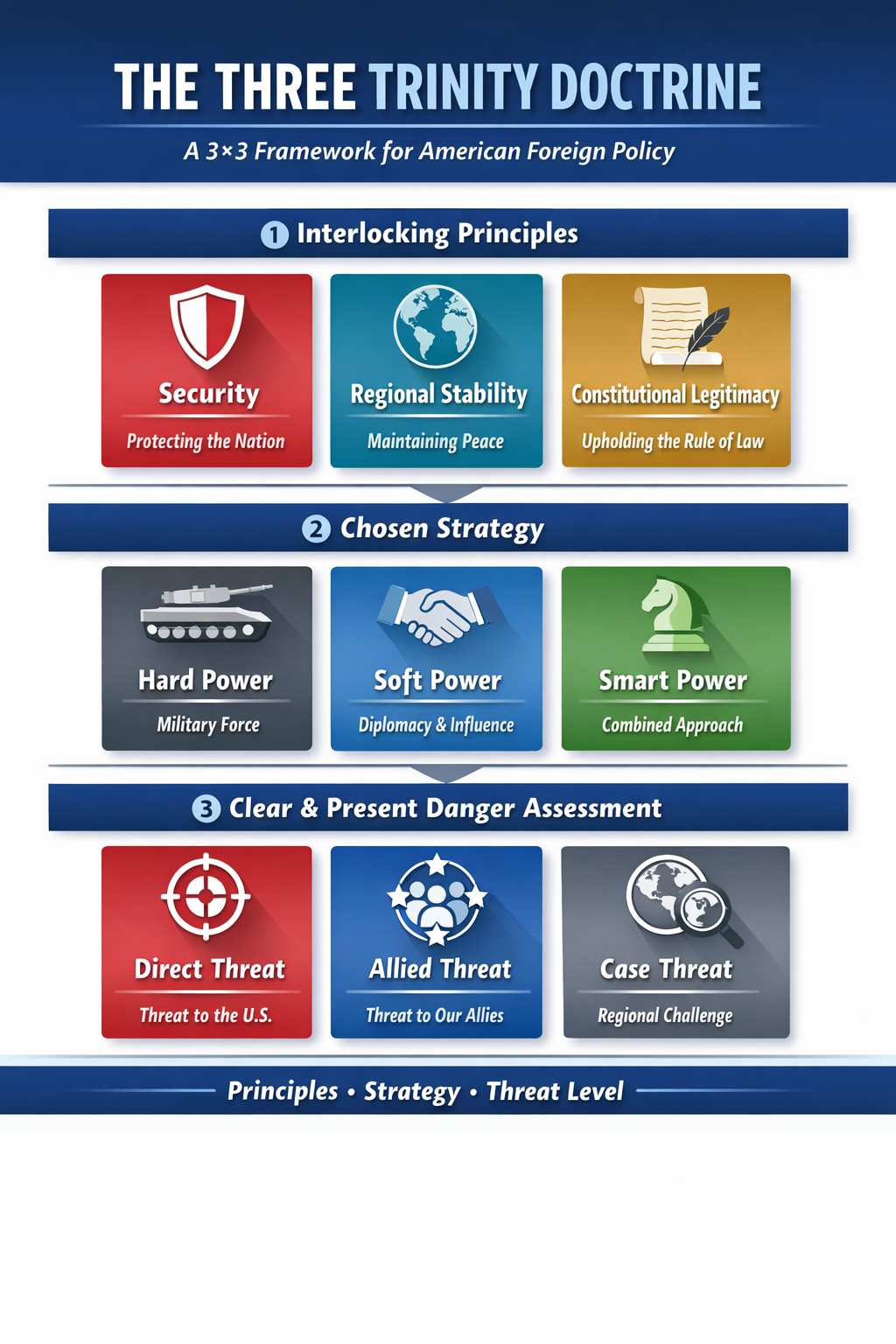
Level One: The Interlocking Principles
Before choosing any strategy, leaders must first ask what core principles are involved.
The Three Trinity Doctrine identifies three:
Security | The most basic responsibility of government is protecting the American people and the nation’s sovereignty. Any crisis must be evaluated to determine whether it threatens national security.
Regional Stability | Even when the United States is not directly threatened, instability in key regions can spread conflict, disrupt global trade, and trigger humanitarian disasters. Stability in the world's major regions is therefore a strategic interest.
Constitutional Legitimacy | American power must remain grounded in the Constitution and the rule of law. Decisions about war, diplomacy, and international agreement must respect the legitimacy of American institutions and democratic consent.
These three principles – security, stability, and legitimacy – form the ethical and constitutional foundation of the doctrine.
Level Two: The Chosen Strategy
Once the interlocking principles are understood, the next question is how the United States should respond.
The Three Trinity Doctrine identifies three strategic tools:
Hard Power | Military capability and deterrence. This includes the use of force, defensive deployments, and credible deterrence against aggression.
Soft Power | Diplomacy, cultural influence, alliances, and economic relationships. Soft power shapes outcomes without forceful coercion.
Smart Power | A strategic combination of hard and soft power applied with precision. Smart power integrates diplomacy, economic tools, and security capabilities into a coordinated response. This level answers the question: What tools should America use to achieve its objectives?
Level Three: The Clear and Present Danger Assessment
Finally, policymakers must determine how serious the threat actually is.
The doctrine identifies three levels of danger:
Direct Threat | A threat to the United States itself – its territory, citizens, or critical infrastructure.
Allied Threat | A threat to a treaty partner or critical ally whose security directly affects American interests.
Case Threat | A regional or global situation that may not immediately threaten the United States or its allies but still requires careful evaluation because of its potential consequences.
This level ensures that American responses remain proportional and disciplined, avoiding both overreaction and neglect.
How the Doctrine Works
When applied together, the Three Trinity Doctrine asks policymakers to examine every crisis through a structured sequence:
Principles | Does the situation affect security, regional stability, or constitutional legitimacy?
Strategy | Should the United States respond through hard power, soft power, or smart power?
Threat Level | Is this a direct threat, a threat to allies, or a case threat requiring monitoring?
This framework creates a disciplined approach to foreign and defense policy, one that avoids impulsive decisions while ensuring that genuine threats are addressed with appropriate seriousness.
Why the Doctrine Matters Now
The modern world is increasingly chaotic. Conflicts emerge quickly, misinformation spreads rapidly, and political pressure often pushes leaders toward reactive decision-making.
The Three Trinity Doctrine offers an alternative: a structured framework for evaluating crises that balances American interests, democratic legitimacy, and global stability.
It allows the United States to act with strength, clarity, and restraint – three qualities essential to responsible leadership in the 21st century.