The State of the Union
Analysis by Ben Everidge for Thomas
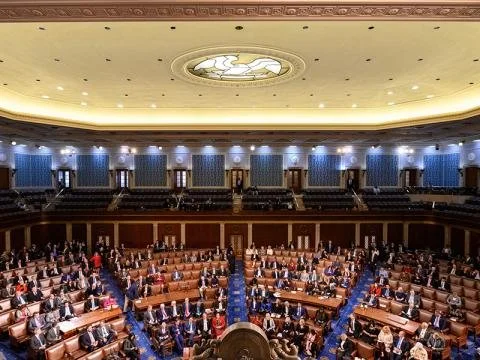
Image: House.Gov
Then and Now: How Speeches Turned into Spectacles and Why Independents Are Losing Patience
A stable middle class does not emerge from speeches. It emerges from predictable tax structures, disciplined spending, regulatory clarity, functioning infrastructure, and reliable institutional enforcement – boring words for a reason: they work.
That was the thesis of The Independent Quill #46, and it’s a thesis that becomes harder to ignore after President Trump’s State of the Union address last night.
Trump used the nation’s biggest annual civic podium to declare an American “resurgence,” claim inflation and key costs have fallen (see our earlier article on this topic here), and showcase a long list of initiatives and symbolic moments.
Yet what was striking wasn’t only what he said, it was what the modern State of the Union has largely become: a broadcast event optimized for superfluous applause lines, viral clips, and factional theater, with policy architecture often treated as optional.
That shift is bigger than Trump. It’s a symptom of how American politics has evolved – technologically, culturally, and institutionally.
When the State of the Union Was More “State” Than “Show”
For most of American history, the State of the Union wasn’t meant to be a prime-time national drama. It was a constitutional requirement – information to Congress about the state of affairs and legislative priorities. But communications technology changed the incentive structure. The moment presidents could reach the public directly, they increasingly spoke past Congress and to voters.
Scholarship and historical accounts trace major inflection points to radio and especially television, which pulled the address toward performance and mass persuasion.
Then, persuasion did the rest. As parties sorted ideologically and media fragmented, the address became a ritual of synchronized standing ovations and choreographed dissent. Recent explainers note the modern pattern: the president’s party rises, the opposition sits, and the chamber becomes a live studio audience.
What Was Distinctive About Trump’s 2026 Address
Trump’s 2026 State of the Union was notable for its length, its eventized structure, and its broad claims of improvement. It was also notable for the 47th president’s finger-wagging admonishment of the political opposition at various points in the speech.
A transcript and live reporting show him arguing that the country is stronger and more prosperous, highlighting immigration enforcement and a wide menu of proposals, and using individual honorees and set-piece moments to reinforce the narrative.
But the speech also became an immediate case study in the modern problem. Once a State of the Union is designed for maximal audience impact, the rhetorical claims can outpace verifiable reality. Multiple outlets published contemporaneous fact-checking and challenged several of the address’s macro claims.
This is the structural dilemma: the address is increasingly treated like a campaign rally inside the Capitol, yet Americans still expect it to function as governance.
How Independents Are Experiencing This Evolution
Independents are not a party; they are a temperament. They tend to be more allergic to political ritual, more skeptical of absolutism, and more focused on whether institutions are working. And the data right now suggests a widening gap between presidential rhetoric and public confidence:
In a late-January 2026 national Marist survey, a majority said the state of the union is not strong, and six in ten said the country is worse off than a year ago; importantly, independents were far more likely to say the nation is not strong.
A YouGov/MarketWatch poll found more than 80% say affordability has not improved – an issue Mr. Trump emphasized as a success story.
Read those together, and you get an independent voter throughline: We are being told to clap while our confidence drops.
Independents are not asking for perfection. They are asking for proof, especially on affordability, institutional functioning, and predictable governance.
Why “Performative Politics” Now Overwhelms Policy Architecture
Three long-term forces are remaking the State of the Union:
1. The audience shifted from Congress to the county
When broadcast becomes the primary purpose, persuasion beats deliberation. Research and commentary on SOTU evolution highlight how technology moved the address from internal governance communication to external political messaging.
2. Parties learned to use it as a loyalty ritual
Standing ovations and conspicuous silence are now part of the script. This doesn’t merely signal disagreement; it trains voters to treat politics as a permanent performance of identity.
3. A “middle-class policy agenda” is slow, technical, and unglamorous
It’s easier to promise or claim a “golden age” than to explain:
Tax-base reform.
Budget discipline.
Regulatory certainty.
Infrastructure delivery.
Enforcement integrity.
Those are multi-year systems projects. They do not fit neatly into applause intervals.
A Comparison Point: What Prior Presidents Tried to Do with the Moment
Even as SOTUs became televised and stylized, the better ones historically sought to marry narrative with governing specificity – wars and peace budgets and programs, structural reforms and national purpose. The modern speech still claims that lineage, but increasingly substitutes:
Personal vignettes for institutional metrics.
Slogans for fiscal mechanics.
Enemies for implementation plans.
That is not unique to one party. Democrats and Republicans have both migrated toward “speechcraft politics,” which is the art of appearing to govern while avoiding the slow work of building durable policy coalitions.
The independent voter’s verdict, in one sentence? Independents are not asking presidents to stop speaking. They are asking them to stop pretending speeches are substitutes for stable governing systems.
What a “SOTU for a Stable Republic” Would Include
If a president truly wanted to speak to the independent center, without pandering, here’s what would be different:
A measurable affordability dashboard (rent, insurance, food, energy) instead of a victory lap.
A three-year deficit path with honest tradeoffs.
A short list of regulatory certainty priorities (permitting, small business compliance, healthcare pricing rules).
A delivery plan for infrastructure and resilience (what gets built, where, and by when).
A rule-of-law commitment that applies to allies and opponents alike.
Because a stable middle class is not spontaneously generated, it’s engineered.