Trump's Fiasco
Opinion by Ben Everidge for Thomas
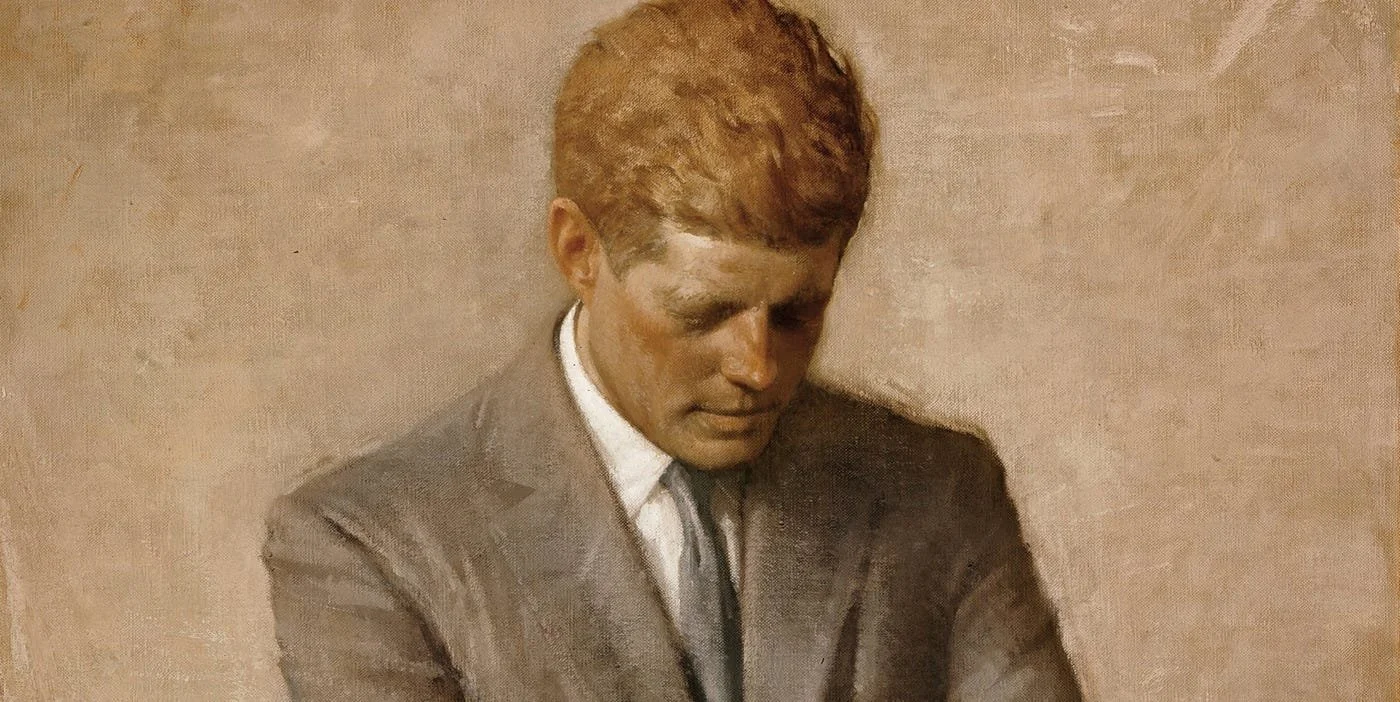
Photo Credit: The White House Portrait by Aaron Shikler
Names, Legacies, and Stewardship and the Meaning of Civic Honor in 2026 …
Disclosure: Everidge writes extensively about the Kennedy Center’s philanthropy in the era of Donald Trump in his forthcoming book, “Generosity: Giving, Getting, and Managing Philanthropy Preeminently.”
Everidge also used, in his 2018 political novel “Hoya: The Watchmen Waketh,” a Kennedy speech that was to have been delivered on the afternoon of his assassination to warn of the need to remain vigilant against threats to American democracy, both from within the United States and abroad.
As America enters the political year ahead, it does so amid renewed debate about what we choose to honor and how. Few moments capture this tension more sharply than the decision to attach Donald Trump’s name to the nation’s most iconic performing arts institution, long dedicated to the memory of John F. Kennedy.
This is not merely a cultural skirmish. It is a political and philanthropic reckoning – one that matters deeply to anyone who believes public generosity carries moral weight and civic responsibility.
Kennedy’s Name as a Civic Trust
The John F. Kennedy Center for the Performing Arts was never intended to be a monument to power. It was meant to be a promise: that the arts are essential to democratic life; that culture belongs to the people; and that public institutions should elevate national character rather than personal brand.
Kennedy himself understood this intuitively. He described artists as truth-tellers and culture as a bridge between freedom and responsibility. The Center bearing his name was established after his assassination, honoring a brilliant life cut short, not celebrating a divisive presidency in progress.
That distinction matters.
Trump and the Rewriting of Honor
Donald Trump has consistently rejected that distinction. Now, in the second year of his controversial second term, he has brought the logic of personal branding directly into the heart of a national cultural institution.
Trump’s relationship with philanthropy has long been transactional and self-referential. His own charitable foundation was dissolved following findings of substantial misuse – an extraordinary outcome for a former president and a reminder that legal charity and ethical stewardship are not the same thing.
Against that backdrop, Trump’s elevation to chair of a significant charitable board in the aftermath of his own philanthropic dethroning, and the subsequent possibly illegal insertion of his name alongside Kennedy’s, raises unavoidable questions:
What does it say about governance when personal legacy eclipses institutional mission?
What message does it send to donors, artists, and the public when an arts institution becomes a stage for political ego?
And how should Americans understand generosity when those previously sanctioned for philanthropic mismanagement are placed atop its most visible platforms?
Philanthropy Is Not Branding
At the intersection of politics and philanthropy, one principle is non-negotiable: philanthropy is stewardship, not self-promotion.
Healthy charitable institutions operate on restraint, transparency, and deference to mission.
Naming rights, when they exist, are traditionally conferred as acts of gratitude, often posthumously, always with humility.
They are not instruments for power consolidation. Kennedy’s legacy at the Center reflected that ethic. Donald Trump’s intervention disrupts it.
This is not about partisan taste. It is about institutional integrity.
When a sitting president inserts himself into the symbolic architecture of national culture, with his dishonorable charitable reputation, the line between public service and personal glorification blurs – and once blurred – it isn't easy to restore.
What This Signals in 2026
As we move deeper into Trump’s second term, the Kennedy Center episode functions as a broader signal of the era we are living in:
Institutions are no longer shielded from personal political ambition
Honor is increasingly self-assigned, not collectively bestowed.
Civic memory is being renegotiated in real time, often without public consent.
For artists, donors, and citizens alike, the risk of fatigue and disengagement is the quiet erosion of trust that makes generosity harder and civic participation thinner.
A Clarion Call for Civic Stewardship
The question before us as 2026 dawns is not whether Trump can place his name wherever he chooses, without the necessary Congressional oversight and approval. Unchecked power often permits that.
The question is whether Americans will accept a redefinition of honor that treats legacy as a marketing asset rather than a public trust.
Kennedy’s name belongs to history because it was earned, not asserted. Kennedy was tragically assassinated. Trump was thankfully nicked in the ear. The institution that bears such names should remain a place where generosity serves the nation, not the other way around.
If philanthropy is to mean anything in the years ahead, it must stand for restraint, accountability, and respect for those who came before us. Otherwise, our civic monuments become mirrors, reflecting not our shared values but our bending of the knee to the ambitions of whoever holds the pen at 1600 Pennsylvania Avenue.
That is not what America is all about. That is not what we, as independent citizens, revere.
About Thomas: Thomas examines the moral architecture of American public life. In 2026, that architecture is clearly under renovation. The question is whether we can distinguish between restoration and demolition.