The Gerrymandered Republic
How Both Parties are Cheating Democracy and Why Americans Should Be Horrified About It
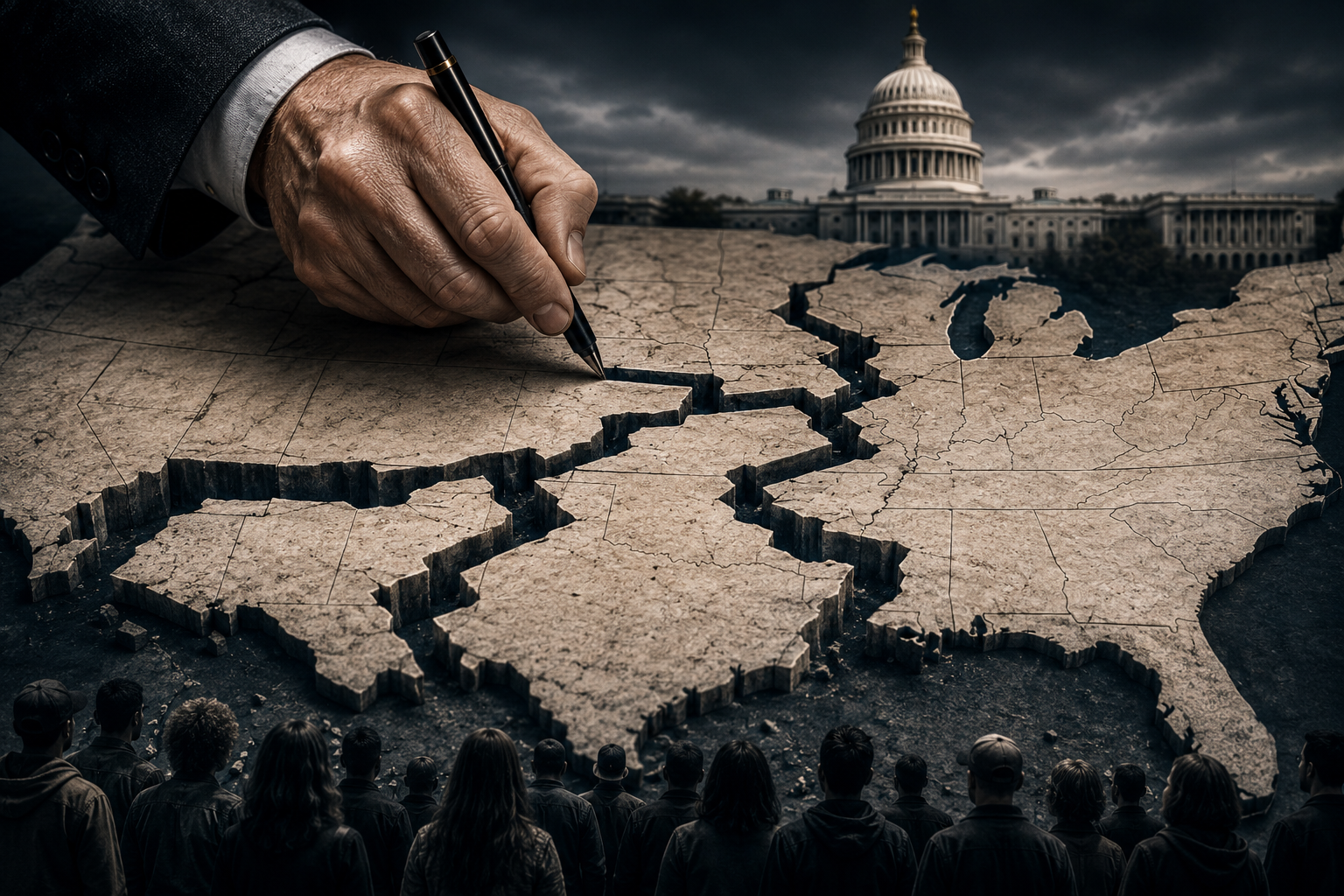
Image: Cannon & Caius generated with AI
Opinion by Ben Everidge for Thomas
I have never forgotten what happened to me during my 1992 campaign for the Florida State Senate.
At the time, I was challenging an incumbent during reapportionment following the census. What happened next taught me more about American politics than any political science class ever could.
The district lines were redrawn.
Not fairly. Not rationally. And certainly not as the Florida or U.S. constitutions envisioned.
My opponent and her party literally drew the district boundary down the middle of the street where I lived to encourage me to run in a different district with an open seat.
My neighbors on one side of the street suddenly lived in one Senate district, while neighbors on my side of the street lived in another – my opponent’s district.
The local newspaper later described the maneuver bluntly as my opponent essentially “gave me the finger.”
Crude? Yes. But, unfortunately, accurate.
Today, more than three decades later, both major political parties continue to engage in the same fundamentally dishonest practice: manipulating district maps to protect political power rather than to represent voters fairly.
Americans should be deeply alarmed and exercised about it.
Gerrymandering Is What It Is – Political Cheating
Let us stop pretending otherwise. Gerrymandering is cheating.
It is the intentional manipulation of electoral district boundaries to predetermine political outcomes before citizens even cast ballots, unfairly.
It allows politicians to choose voters rather than have voters choose politicians.
Both parties do it.
Democrats do it when they control states. Republicans do it when they control states.
Each side publicly condemns it while quietly defending its own maps.
That hypocrisy has become one of the most corrosive features of modern American politics.
The Constitution Was Never Designed for Engineered Elections
The founders expected political competition. They expected disagreement. They expected ambition.
But they did not envision a system where sophisticated data modeling and partisan mapmaking would allow political parties to engineer “safe” districts with surgical precision.
The Constitution assumes elections possess meaningful competition.
Without competition, accountability weakens, moderation declines, compromise disappears, and extremism grows stronger.
Safe districts reward ideological rigidity because the only real political threat becomes a primary challenge from the party’s ideological base.
That is one reason Congress increasingly behaves less like a governing institution and more like a permanent cable television argument.
Mid-Decade Gerrymandering Is Even Worse
The newest trend may be the most dangerous yet. It is mid-decade redistricting.
Traditionally, reapportionment followed the census every ten years.
Now, political parties increasingly seek to redraw maps repeatedly whenever a political opportunity emerges.
That transforms representative democracy into a never-ending boundary war.
The rules become fluid. The process becomes opportunistic. And public trust deteriorates even further.
Americans increasingly suspect elections are manipulated, outcomes are engineered, and constitutional fairness is secondary to partisan advantage.
That perception alone damages democratic legitimacy. It is worse when perception is reality as it is.
Gerrymandering Is Helping Destroy Public Trust
This matters far beyond district maps. Trust in Congress, elections, institutions, and democracy itself is already dangerously low and diving lower.
What message does aggressive and intentional gerrymandering send to voters?
Essentially, this: “The parties no longer trust voters enough to compete fairly.”
That is toxic for a constitutional republic. Admit it.
Especially among younger Americans already questioning whether institutions work honestly, representation is meaningful, or political participation changes anything at all.
Both Parties Are Responsible
This is where many Americans grow understandably frustrated.
Democrats often speak passionately about democracy while defending aggressive maps in states they control, such as California and Virginia.
Republicans frequently defend constitutional originalism while simultaneously pursuing heavily engineered districts favorable to their own power in states like Texas and Florida.
Neither side emerges clean, and Americans are more than aware of it.
It is no wonder, then, that independent voter registration continues to grow nationwide, eclipsing both Democratic and Republican party registration.
Millions of Americans increasingly feel trapped between two parties demanding loyalty while manipulating the rules themselves.
Gerrymandering Is Not Clever Politics – It Is Democratic Weakness
Political insiders often treat redistricting as strategic brilliance.
It is not.
“When politicians draw maps to protect themselves rather than represent citizens, democracy stops functioning as competition—and starts functioning as management.”
Healthy democracies do not fear competitive elections. Only insecure political systems require heavily engineered outcomes to preserve power.
Strong political parties should persuade voters. Not redraw them.
What Reform Could Look Like
The answer is not partisan revenge. The answer is structural reform.
Several possible reforms deserve serious national discussion.
Independent redistricting commissions.
Stronger compactness requirements.
Mid-decade redistricting restrictions.
Transparent public map review.
Ethical judicial review standards.
Greater constitutional scrutiny of engineered districts.
No system will ever be perfect. But the current system increasingly lacks legitimacy, and legitimacy matters enormously in democratic government.
Why This Matters More Than Politicians Admit
Many Americans understandably focus on inflation, war, taxes, immigration, and affordability.
But representative legitimacy underlies all of those debates.
If citizens stop believing elections are fundamentally fair, the constitutional system itself weakens or collapses.
The founders understood this deeply. That is why they feared concentrated power so intensely.
Gerrymandering is ultimately about power. Who keeps it? Who loses it? Whether voters genuinely control it.
The Thomas Take
At Thomas, we believe Americans should reject the idea that democracy must always function this way. It does not, and it should not.
A constitutional republic cannot remain healthy if politicians increasingly manipulate districts, institutions lose legitimacy, and voters feel structurally powerless.
The answer is not cynicism. The answer is reform serious enough to restore confidence that elections still belong to citizens rather than political cartographers. Because if Americans lose faith that representation itself is fair, the republic eventually pays the price.