Warning!

The 2028 Election Will Not Be Normal
Image: Adobe Stock generated with AI by Ben (not Everidge)
Every presidential cycle is described as “the most important of our lifetime.” Most are not.
But some elections are different, not because of personalities, but because of the conditions surrounding them.
The 2028 presidential election is shaping up to be one of those moments.
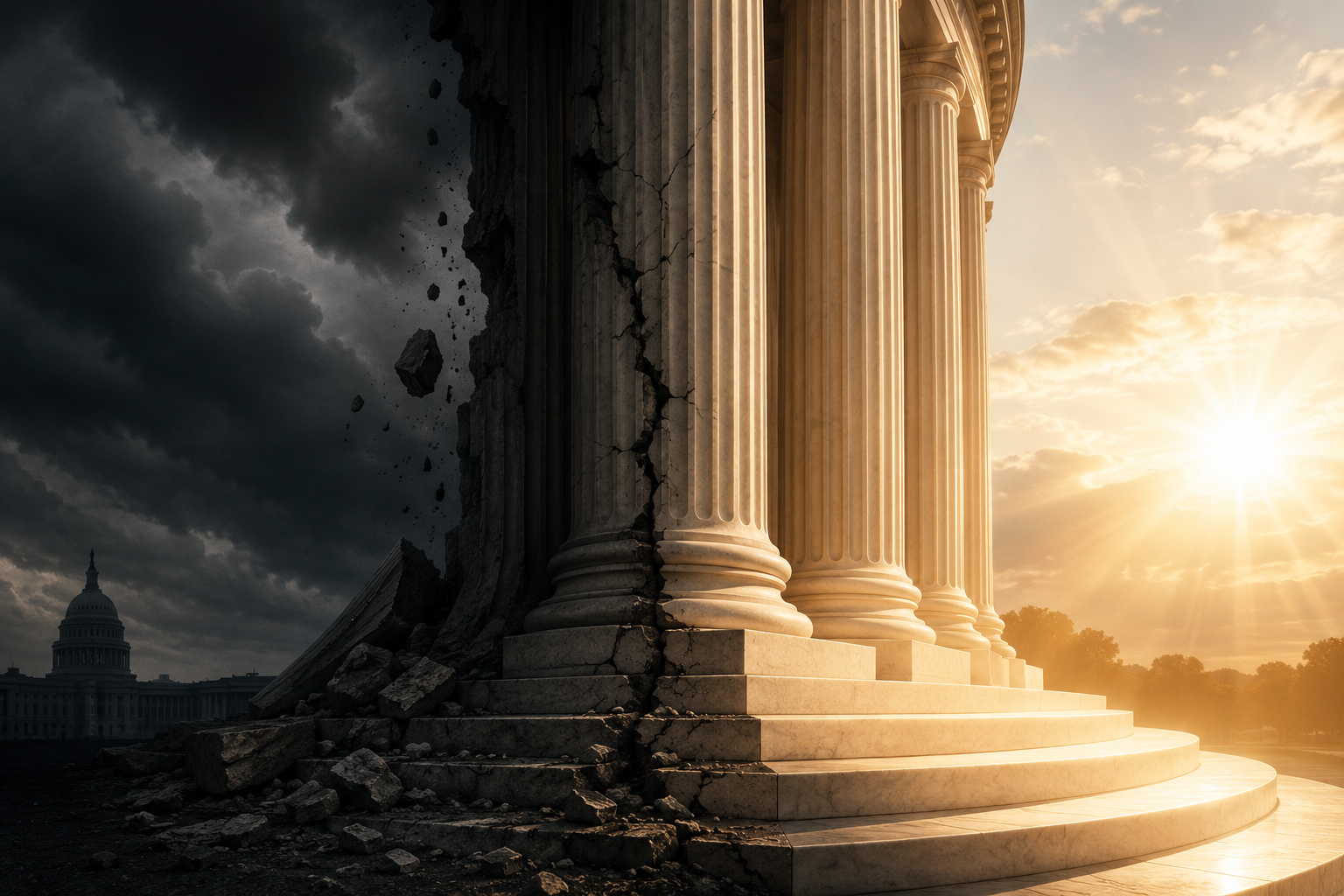
Not simply a contest between candidates. But a stress test of our constitutional system itself.
The Third-Term Question
At the center of this emerging tension is Donald Trump's suggestion that he may seek a third term, grounded in the argument that the 2020 election was improperly decided.
The constitutional reality is clear: The Twenty-Second Amendment limits presidents to two elected terms.
There is no provision for an exception based on disputed elections.
Courts, audits, and certifications across multiple states have consistently found no evidence of outcome-determinative fraud in 2020. No evidence.
This matters, not as a partisan point, but as an institutional one.
If constitutional limits become subject to reinterpretation based on political claims, then the stability of the system itself is placed at risk.
The Reciprocity Problem
If one constitutional boundary is challenged, others inevitably come into view.
A natural question arises. Could Barack Obama seek another term for Democrats under a similar rationale?
The answer, again, is constitutional. No.
The 22nd Amendment applies universally, not selectively.
But the discussion itself reveals something deeper. When rules are questioned in one direction, they are questioned in all directions.
This is how constitutional norms begin to erode, not through immediate collapse, but through reciprocal pressure.
The Gap Between Promise and Performance
The 2028 election will also unfold against the backdrop of unmet expectations.
“America First” was presented as a doctrine of economic renewal, reduced foreign entanglements, and stronger domestic stability.
To the extent that these promises have not fully materialized or have produced mixed results, the political consequences are significant.
Not simply for one candidate. But for the broader question. Can large, populist promises translate into durable governance?
Voters who feel that promises were not fulfilled may shift in the 2026 mid-term elections and again, even more so, in the 2028 cycle.
Voters who remain loyal may double down.
The result is not clarity, but intensified division.
The Structural Challenge: Gerrymandering
Beyond candidates and messages, the structure of elections themselves shapes outcomes.
Congressional districting, controlled largely at the state level, has produced districts that are often highly predictable, politically insulated, and less competitive.
This is not a new phenomenon. But its effects have deepened.
When most elections are effectively decided in primaries rather than general contests, incentives shift toward ideological purity, away from compromise, and toward performance rather than governance.
This contributes directly to the dysfunction many Americans observe.
The Oversight Vacuum
The Constitution assigns Congress a central role – authorizing major actions, overseeing the executive, and representing the people.
In recent years, that role has weakened.
Oversight has become inconsistent, often partisan, and sometimes absent.
When Congress does not fully exercise its authority, power naturally flows elsewhere.
This is not a partisan observation. It is a structural one.
The Election System Under Strain
The integrity of elections is not only about ballots. It is about confidence.
As discussed in earlier Thomas essays:
The system has largely been held under scrutiny.
But public trust has declined remarkably.
If the 2028 election unfolds in an environment where rules are contested, outcomes are questioned in advance, and institutions are deeply distrusted. The election becomes not just a vote but a contest over legitimacy.
What Makes 2028 Different
Several factors converge:
Constitutional boundaries are being publicly tested.
Public trust in institutions remains low.
Structural features of elections limit competition.
Congress has not consistently asserted its role.
Political narratives increasingly challenge outcomes themselves.
Taken together, these create conditions for an election that is more contested, more uncertain, and more consequential than usual.
A Thomas Reflection
At Thomas, we resist the pull to frame this moment in partisan terms.
The issue is not who benefits. The issue is whether the system holds.
The Constitution does not depend on agreement. It depends on adherence.
What Must Be Reinforced
To ensure that the 2028 election strengthens rather than weakens the republic, several principles must be reaffirmed:
Constitutional Limits Must Be Observed | Not debated and not reinterpreted for convenience. Observed.
Election Legitimacy Must Be Protected | Through transparency, consistent rules, and responsible leadership.
Congress Must Reassert Its Role | Oversight is not optional. It is essential.
Competition Must Be Strengthened | Where possible, reforms that encourage competitive elections should be considered. A healthy democracy requires meaningful choice.
Citizens Must Engage Seriously | Not as spectators. But as participants in a constitutional system.
The Defining Constitutional Order
The 2028 election will not be normal. But then, perhaps it should not be.
Moments of strain reveal the strength – or weakness – of a republic.
The question is not whether tensions will arise. They will.
The question is whether American leaders and citizens will choose to resolve them within the constitutional order that defines the nation.