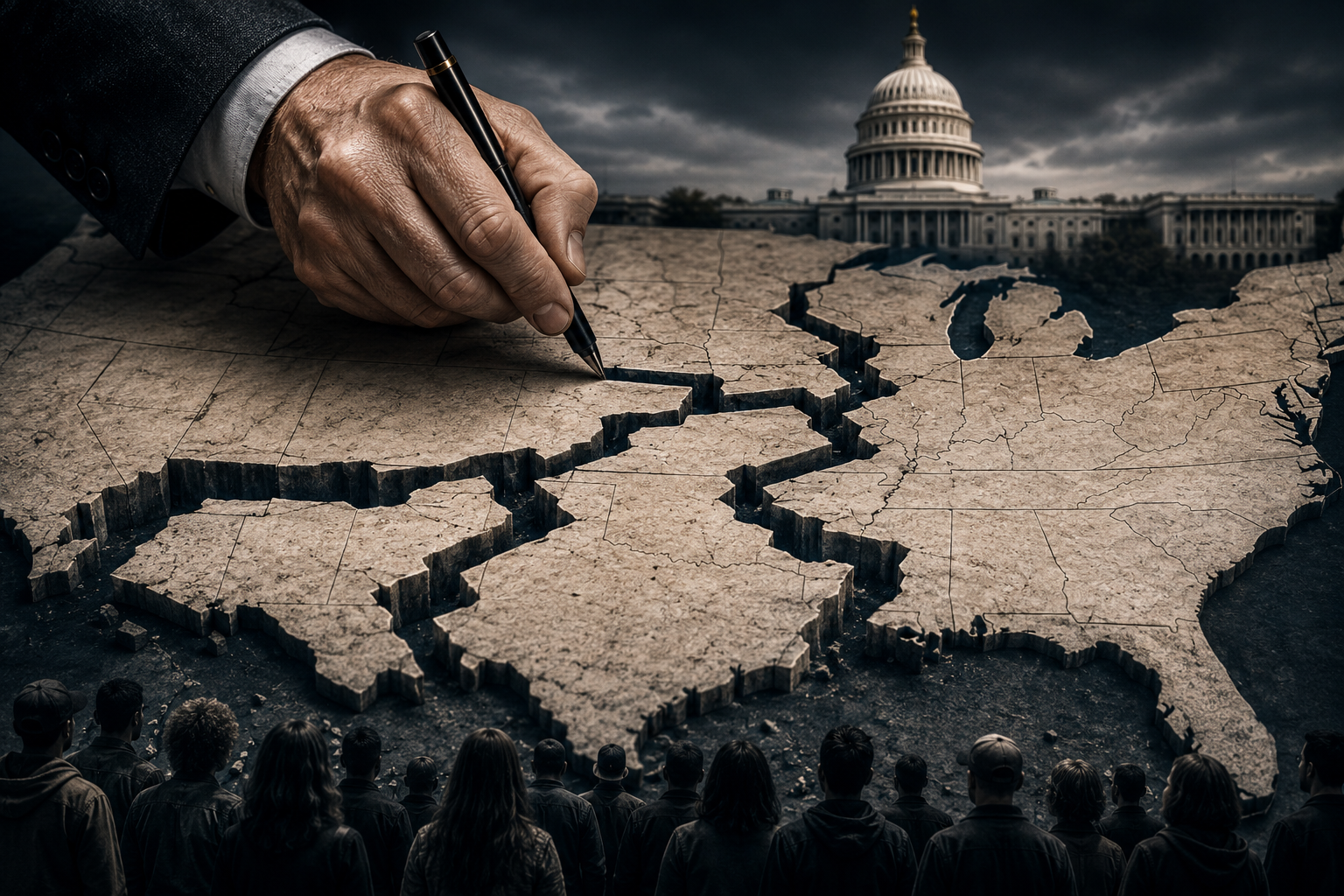
Beyond the Political Pendulum

Why America’s Future Depends on Constitutional Renewal Rather Than Ideological Extremes
Opinion by Ben Everidge for Thomas
Image: Adobe Stock modified by AI from the original design by trahko
“The greatest challenge facing the American Republic is not choosing between competing political extremes. It is rediscovering the constitutional center that has sustained our democracy for more than 250 years.”
A Republic at a Crossroads
Every generation inherits its own political tests.
The generation of the Founders confronted monarchy. The Civil War generation confronted slavery and disunion. The twentieth century confronted fascism and communism.
Our generation faces a different challenge.
It is watching two powerful political movements pull American politics in opposite ideological directions while millions of Americans increasingly wonder whether either movement truly represents them.
On one side stands a populist movement that has reshaped the Republican Party around the MAGA (Make America Great Again) coalition. On the other, democratic socialist candidates have gained visibility and electoral success in parts of the Democratic Party, particularly in urban primaries and among some young voters.
Recent polling suggests roughly one-third of Democratic-leaning adults view political leaders who identify as democratic socialists positively, while most remain neutral and Americans overall are more likely to view such leaders negatively than positively.
Neither should be dismissed. Neither should be exaggerated. Both deserve serious examination.
The Common Thread
Although these movements differ dramatically in philosophy, they emerge from similar frustrations.
Many Americans believe:
Government is not producing measurable results.
Economic opportunity has become less attainable.
Institutions have lost public confidence.
Housing, healthcare, education, and everyday living have become less affordable.
Politics has become performative rather than productive.
These concerns are real.
The question is how best to address them.
When Ideology Becomes the Destination
Healthy democracies need vigorous ideological debate. But democracies become less healthy when ideological identity becomes more important than constitutional principles or measurable outcomes.
The question should never be, “Which ideology wins?” The better question is, “Which policies strengthen constitutional government while improving the lives of Americans?”
The Lessons of History
History offers warnings about concentrating political power, whether in government, parties, or individuals.
At the same time, history also demonstrates that democratic societies can successfully address inequality, strengthen opportunity, and expand prosperity without abandoning constitutional democracy.
America’s greatest achievements have generally come not from ideological purity but from constitutional adaptation, innovation, and reform.
The Independent Majority
One of the most remarkable developments in modern politics is the continued growth of independent voters.
Millions of Americans no longer feel fully represented by either major party.
Some lean conservative. Others lean progressive. Many hold views that cannot easily be placed on the traditional left-right spectrum.
What often unites them is not ideology. It is a desire for practical government, constitutional accountability, economic opportunity, fiscal responsibility, affordable living, secure communities, and public officials who deliver measurable results.
That desire helps explain why so many Americans describe themselves as politically independent.
Beyond Ideology
The future of American politics may not belong to whichever ideology shouts the loudest.
It may belong to those willing to ask different questions.
Instead of asking whether a proposal is conservative or progressive, ask:
“Does it work?”
“Does it strengthen constitutional government?”
“Does it improve affordability?”
“Does it expand opportunity?”
“Does it respect individual liberty?”
“Does it preserve democratic institutions?”
“Does it leave the country stronger?”
Those questions should become the new political scorecard.
Building a Constitutional Reform Movement
If an organized independent movement is to emerge viably, its greatest strength will not be ideological moderation for its own sake. Its strength will be constitutional clarity and accountability.
Such a movement would measure success by outcomes rather than slogans.
It would judge every administration – Republican, Democratic, or Independent – by common standards:
Stronger economic opportunity.
Lower cost of living.
Fiscal responsibility.
Accountable government.
Constitutional fidelity.
Public trust.
National security.
A measurable improvement in citizens’ daily lives.
Those are standards that transcend party labels.
The Thomas Take
“The future of the American Republic will not be secured by ideological purity. It will be secured by constitutional fidelity, measurable results, and leaders who remember that the people are greater than the party.”
American politics has always evolved.
Parties rise. Parties change. Coalitions realign. The Constitution endures.
The challenge before the nation is not choosing between two competing ideologies. It is ensuring that every political movement remains anchored to the constitutional principles that have made self-government possible.
Americans deserve vigorous debate. They deserve competing ideas. They deserve accountable leadership.
But they also deserve a politics that places constitutional government above ideological victory and measurable progress above permanent conflict.
Perhaps the defining political question of the next decade is not whether America moves left or right. It is whether America moves forward.
The answer will depend not on which ideology prevails, but on whether leaders of every persuasion remember that they serve a constitutional republic before they serve a political movement.