Not a Pax Americana
Opinion by Ben Everidge for Thomas
Photo Credit: Adobe Stock with AI by Johannes
When THE U.S. Forgets It Was Meant to Lead, Not Rule Unilaterally …
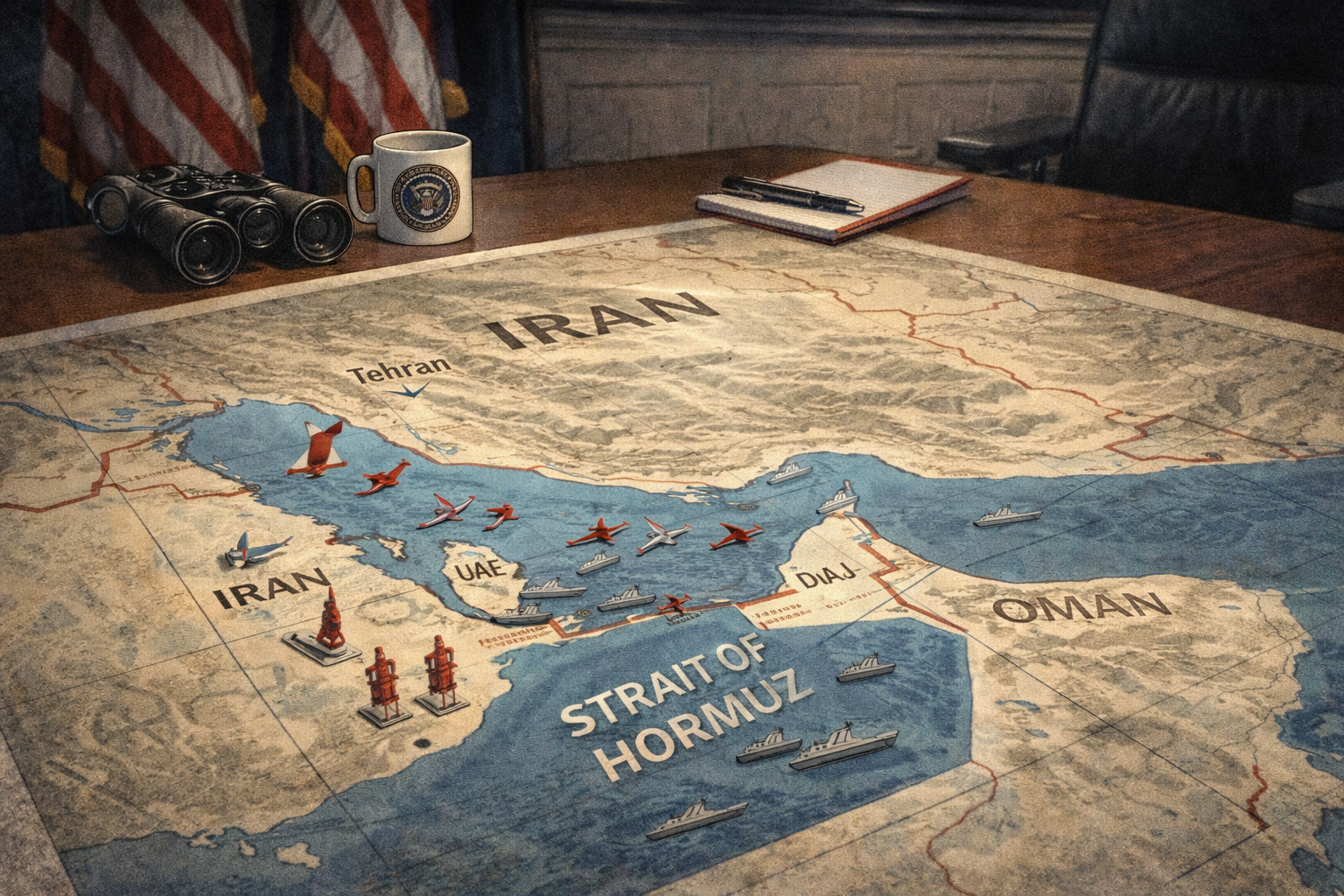
In the unfolding chaotic and divisive second term of the 47th president of the United States, a troubling sub-theme has begun to crystallize – what might best be characterized as Imperial Overdrive.
It is neither a formal empire nor classic isolationism. It is something far more erratic: a foolish posture that treats allies as obstacles, institutions as irritants, and diplomacy as a zero-sum performance.
This matters and should concern us because America’s historic strength has never rested on coercion alone. It rested on alliances, legitimacy, and restraint – the very qualities now under strain.
From Pax Americana to Personal Dominance
When John F. Kennedy spoke of peace in the early 1960s, he rejected the idea of enforced order – “not a Pax Americana enforced on the world by American weapons of war.” His vision was leadership through partnership, persuasion, and shared security.
Imperial Overdrive inverts that logic. It confuses dominance with durability. It mistakes disruption for strategy. And it risks turning the idea of American leadership into a transactional demand rather than a shared project.
Greenland and the Fracturing of Trust
President Trump’s head-scratching messaging around Greenland – oscillating between strategic interest, coercive rhetoric, and dismissive humor – has driven a wedge between the United States and key partners: Denmark, the European Union, the United Kingdom, Canada, and the alliance that binds them all, the North Atlantic Treaty Organization, widely known as NATO.
Greenland is strategically important. That is not in dispute. What is in dispute, as with many things Trump, is the method – the process.
Strategic interests advanced through insult, threat, or spectacle do not strengthen leverage. They erode it. Allies, predictability begins to hedge. Adversaries start to probe. And Canada, as we have seen, is running into the arms of China, which is gleefully celebrating the disintegration of the post-World War II order.
Tariffs: Picking Fights with Friends
A defining feature of Imperial Overdrive is misdirected economic warfare. Tariffs can be legitimate tools against hostile or predatory actors. They are far less defensible when aimed at long-standing allies whose cooperation amplifies U.S. power.
Trade wars with friends fracture supply chains, weaken political goodwill, and encourage precisely the kind of bloc-building among rivals that American strategy has historically sought to prevent. The irony is stark: in attempting to appear strong, the United States risks standing alone and appearing desperately weak.
NATO: A Success Story Treated as a Burden
For more than seven decades, NATO has done precisely what it was designed to do: deter great-power war in Europe, integrate former adversaries, and project stability. It has evolved, adapted, and expanded – often imperfectly, but effectively.
To treat NATO primarily as a cost center rather than a strategic multiplier is to misunderstand its value. Celebrating its success does not preclude reform. But undermining its legitimacy in public while demanding loyalty in private is a recipe for alliance fatigue.
The “Peace Board” Problem
Trump’s proposed Peach Board for the Gaza region fits the Imperial Overdrive pattern precisely. Rather than reform or strengthen existing institutions – flawed as they may be – it attempts to replace multilateral legitimacy with unilateral branding.
Institutions work best when presidents negotiate within them, not around them. Reform requires patience, credibility, and respect. Chaos and insults may dominate headlines, but they do not build peace.
Imperial Overdrive vs. Principles of International Relations
Classical international relations theory is clear on a few essentials here:
Legitimacy matters as much as power
Alliances deter conflict more reliably than threats
Predictability stabilizes systems
Hegemony without consent invites resistance
Imperial Overdrive violates each principle in turn.
The Three Trinity Doctrine: A Proposed Corrective
This is where my Three Trinity Doctrine theory becomes relevant as a governing alternative. While not branded as such internationally, its logic is intuitive:
1. Power, Purpose, and Partnership must move together
2. Sovereignty, Security, and Stability must be balanced, not weaponized against allies
3. Diplomacy, Defense, and Development must reinforce one another, not compete
Imperial Overdrive severs these trinities. It elevates power over purpose, sovereignty over stability, and defense over diplomacy.
Read more about the Three Trinity Doctrine here.
What America Should Be Doing Instead
A serious American foreign policy in 2026, I argue, would:
Strengthen alliances through negotiation, not humiliation
Target economic pressure at adversaries, not allies
Celebrate NATO’s achievements while modernizing its mission
Reform institutions through leadership, not replacement
Restore predictability as a strategic asset
This is not a weakness. It is wisdom earned the hard way.
Empires fall not only from overreach but from forgetting why others followed them in the first place.
America was never meant to be an empire in overdrive. It was meant to be a leader – credible, steady, and trusted.
If the United States abandons that role, it will not be replaced by chaos elsewhere. It will be replaced by powers far less interested in freedom, dignity, or peace.
Thomas exists to defend leadership without hubris and strength without swagger. In an age of Imperial Overdrive, restraint may once again be America’s most radical – and necessary – strategy.