The "Big Beautiful" Corruption Fund?
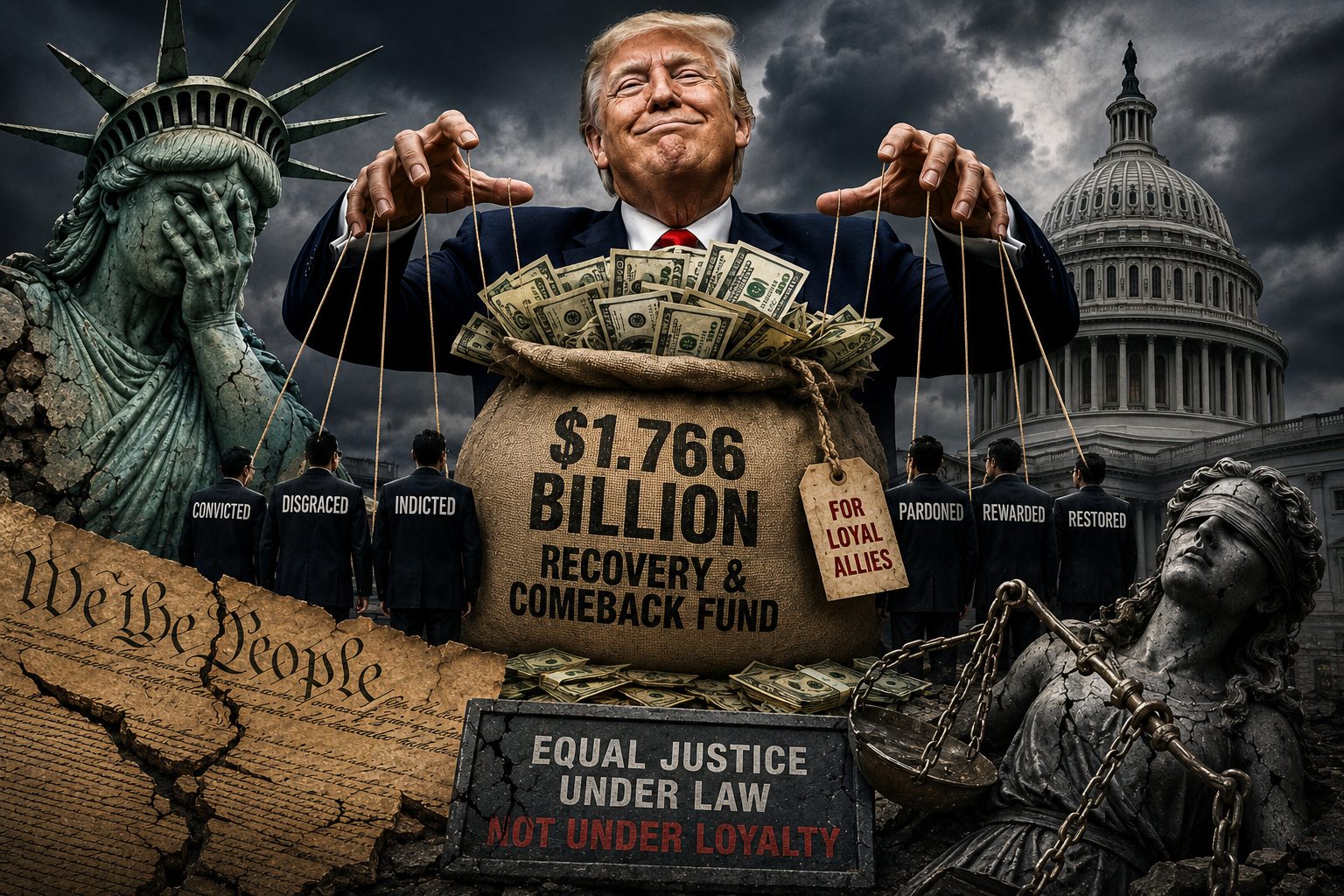
Why the Proposed $1.766 Billion Political Recovery Fund Raises Serious Constitutional and Democratic Questions
Opinion by Thomas
Image by Cannon & Caius generated with AI
A dangerous line has been crossed
Washington has witnessed many controversial spending bills over the decades. But the emerging proposal involving the reported $1.766 billion Department of Justice-linked recovery and political rehabilitation structure benefitting discredited Trump allies represents something far more troubling than ordinary political favoritism.
If accurately characterized, and thus far we have no reason to believe otherwise, this is not merely partisan spending, political patronage, or ideological policymaking. It represents something much deeper – the normalization of state-adjacent political rehabilitation financed by government power structures at the expense of the American taxpayer/voter.
Americans of all political affiliations should be alarmed by this possibility.
The Core Constitutional Question
At the center of this historic controversy is a basic constitutional issue. Should executive power and federal institutional machinery ever be used – directly or indirectly – to politically restore, reward, protect, or financially rehabilitate allies tied to criminal convictions, ethical misconduct, or anti-democratic/anti-constitutional behavior?
That question matters enormously because constitutional democracies depend on the equal application of the law, institutional neutrality, and public confidence that justice is not politically transactional.
Once citizens begin to believe that prosecutions are political, pardons are political, investigations are political, and financial rehabilitation itself becomes political, the legitimacy of constitutional governance weakens rapidly.
Why Critics – and We – See This as a “Corruption Bill”
Critics – and we agree – increasingly argue that this proposal resembled a political loyalty recovery fund.
The concern is not merely the amount of money involved.
It is the symbolism as well.
If individuals convicted by juries, sentenced by judges, and investigated through lawful judicial process can later become beneficiaries of politically aligned financial restoration mechanisms tied to executive influence, then Americans naturally begin asking, “Is accountability still real? Is our democracy still valid?”
That question becomes even more explosive when some of the judges involved were themselves Republican-appointed.
At that point, claims of universal political persecution become harder to sustain objectively.
The Constitutional Stress Point
The founders feared concentrated systems of executive loyalty intensely.
Why?
Because republics historically weaken when personal loyalty supersedes institutional loyalty, leaders reward allies above constitutional norms, and justice becomes associated with factional allegiance.
The Constitution was specifically designed to avoid court politics, patronage empires, and systems of executive favoritism.
That is why Congress controls appropriations, courts remain independent, and institutional accountability mechanisms exist.
The concern now is whether those safeguards are weakening under modern hyper-partisan pressure.
The Republican Fracture Matters
One reason this issue is politically significant is that opposition is finally emerging not only from Democrats but from Republicans themselves.
When Susan Collins of Maine, Lisa Murkowski of Alaska, Bill Cassidy of Louisiana, Thom Tillis of North Carolina, Rand Paul of Kentucky, and others express concern or opposition, the issue moves beyond ordinary partisan warfare.
It becomes an institutional legitimacy issue.
These senators are not ideological revolutionaries.
Most are institutional Republicans concerned about constitutional process, fiscal responsibility, political optics, and institutional credibility.
That distinction – that difference – matters.
The Appearance Problem Is Severe
Even if Trump defenders argue the fund is technically lawful, procedurally justified, or politically defensible, the appearance problem among the American public remains enormous.
Public trust in Congress, the Department of Justice, federal law enforcement, and the presidency is already dangerously weak.
A proposal perceived as a government political rehabilitation of presidential allies risks reinforcing the belief that the law is selective, accountability is partisan, and power protects itself.
That perception is extraordinarily corrosive in constitutional democracies.
This Is Bigger Than Donald
This point is critical.
The deeper issue is not one that a single president can address. It is precedent.
Because once executive-aligned political rehabilitation structures become normalized, future administrations may expand them further.
Every constitutional shortcut eventually becomes available to successors. That is how republics gradually redefine acceptable conduct.
The Founders Would Have Recognized the Danger Immediately
Hamilton feared demagogic concentration of loyalty.
Jefferson feared monarchical tendencies.
Madison feared that a faction would overwhelm institutional balance.
All three would likely recognize the warning signs here: personal loyalty systems, politicized distrust of institutions, executive centralization, and weakening constitutional guardrails.
The founders understood something modern America increasingly forgets. Constitutional corruption often emerges gradually through normalization rather than sudden collapse.
So, How Should This Be Characterized?
Objectively and politically, several phrases likely fit:
Executive patronage expansion.
Institutional favoritism.
Constitutional stress politics.
Loyalty-state governance.
Post-accountability normalization.
Factional rehabilitation politics.
And yes, critics calling it “The Big Beautiful Corruption Bill” are making a politically understandable argument because the Trump/DOJ proposal appears to blur the lines among justice, loyalty, governance, and political restoration in ways many Americans find profoundly troubling.
“The moment citizens believe justice depends more upon political loyalty than constitutional principle, the republic itself begins absorbing the damage.”
Clearly, if the President has to be protected from the federal government – his own federal government – from being prosecuted for past misdeeds, then, too, he must have done something wrong that is prompting this “Big Beautiful Corruption Bill” to come to his rescue.
The Thomas Take
At Thomas, we believe republics survive only when citizens maintain confidence that institutions remain larger than personalities, that the law applies consistently, and that public office serves the constitutional order rather than factional reward systems.
That trust is already dangerously strained in modern America.
The greatest danger may not be a single controversial bill. It may be the normalization of executive favoritism, institutional loyalty politics, and public exhaustion with constitutional standards themselves.
Because once citizens conclude accountability depends entirely upon political alignment, constitutional democracy enters deeply unstable territory.
And history suggests republics rarely strengthen from that condition.