Vicars of State
America’s Most Prominent Chief Diplomats and the Power Behind the Presidency
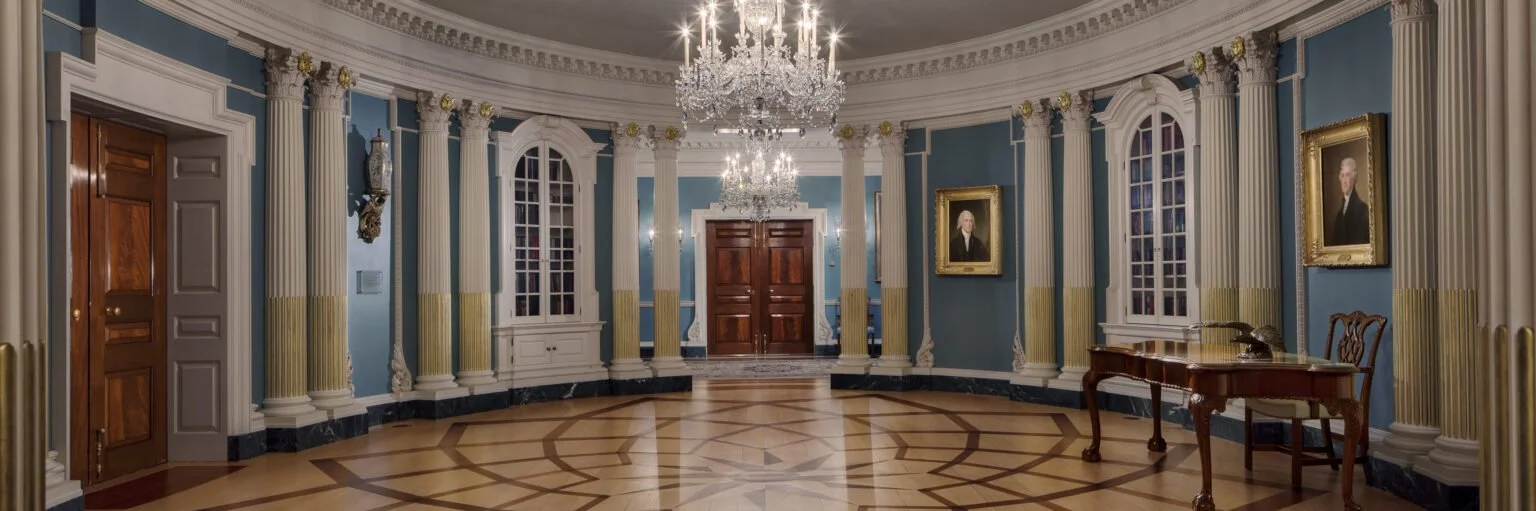
Image: U.S. Department of State
Presidents shape history. But they do not do so alone
Behind every consequential presidency stands a figure often less visible, yet no less essential – the Secretary of State, our nation’s chief diplomat.
At their best, these individuals are more than administrators of foreign policy. They are:
Interpreters of the world to the president.
Representatives of America to the world.
And, at times, independent architects of history.
In this article, let’s examine those who rose above the office. Those who did not simply serve presidents, but helped define eras.
What Makes a Chief Diplomat “Preeminent”?
Not all Secretaries of State are equal in influence.
The most prominent shares several characteristics:
Proximity to presidential decision-making.
Independent strategic judgment.
Ability to manage global crises.
Lasting impact on American foreign policy.
They are not merely implementers. They are co-authors of American statecraft.
The Foundational Figures
Thomas Jefferson | Before he was president, Jefferson served as America’s first Secretary of State. He helped define the early posture of the United States through cautious engagement abroad, emphasis on republican values, and skepticism of entangling alliances. His tenure established the office as both a philosophical and a diplomatic role.
James Madison | Madison translated theory into practice. As Secretary of State, he navigated the fragile early republic through intensifying tensions with Britain and France, helping to define the operational limits of American neutrality. His diplomatic stewardship laid the groundwork for the War of 182 and affirmed the United States’ sovereignty on the world stage.
John Quincy Adams | Perhaps the most intellectually formidable Secretary of State in American history. Adams negotiated the Adam-Onís Treaty, securing Florida and shaping the continental boundaries of the United States. He also helped articulate what would become the Monroe Doctrine.
Divided & Expanding Nation Navigators
John Hay | Hay ushered the United States onto the global stage as a modern power. Through the Open Door Policy, he advanced American commercial access to China while promoting a balance of power among empires. Hay’s diplomacy reflected a nation stepping confidently into international leadership.
William Seward | Seward redefined American ambition during and after the Civil War. Best known for the acquisition of Alaska, once mocked as “Seward’s Folly,” he saw beyond immediate criticism to long-term strategic value. Seward’s diplomacy helped preserve the Union’s international standing while quietly expanding its global reach.
The Architects of American Power
George C. Marshall | Marshall’s legacy rests on one of the most ambitious diplomatic and economic initiatives in history: The Marshall Plan. In rebuilding post-war Europe, he helped stabilize allies, contain Soviet influence, and lay the foundation for decades of Western prosperity.
Cordell Hull | Hull, the longest-serving Secretary of State, championed global economic cooperation as a pathway to peace. He was instrumental in the creation of the United Nations and laid the groundwork for the modern international economic system. Hull believed that open trade and diplomacy could prevent the kind of conflicts that defined the early 20th century.
John Foster Dulles | Dulles advanced a doctrine of strong containment rooted in alliance and deterrence. He promoted collective security through global partnerships and emphasized moral clarity in confronting communism. His tenure helped institutionalize America’s Cold War posture.
Henry Kissinger | Few figures shaped modern diplomacy more than Dr. Kissinger. Operating under Presidents Nixon and Ford, he pursued détente with the Soviet Union, the opening of China, and a realpolitik-driven global strategy. His approach remains debated, but his influence is undeniable.
The Cold War Strategists
Dean Acheson | Acheson was instrumental in shaping early Cold War policy. He helped design NATO, the containment strategy, and the institutional framework of American global leadership.
Dean Rusk | Rusk served during one of the most turbulent periods in American history. A steadfast advocate of containment, he supported U.S. involvement in Vietnam as part of a broader Cold War strategy. His tenure reflects the tension between strategic doctrine and political reality.
George Shultz | Serving under President Reagan, Shultz played a key role in the endgame of the Cold War. His diplomacy combined firmness with engagement, helping bring about a peaceful conclusion to a decades-long geopolitical struggle.
The Modern Era Masters
James Baker | Baker’s tenure under President George H.W. Bush is often viewed as a model of effective diplomacy. He managed the end of the Cold War, German reunification, and coalition-building during the Gulf War. His approach demonstrated the power of disciplined, relationship-driven diplomacy.
Madeline Albright | Albright championed American leadership in a post-Cold War world. She advocated for democracy, human rights, and NATO expansion, helping to define the United States’ role as the indispensable nation in a unipolar moment.
Colin Powell | Powell brought credibility and restraint to diplomacy. Known for the “Powell Doctrine,” he emphasized clear objectives and, when necessary, overwhelming force, while seeking to maintain international legitimacy and coalition support.
The Role in Context
These figures differ in philosophy, style, and results. But they share a common thread. They operated not merely as advisors but as extensions of presidential authority abroad.
In many cases, they shaped outcomes that presidents alone could not have achieved.
The Tension Within the Role
The Secretary of State must balance competing demands:
Loyalty to the president.
Fidelity to long-term national interests.
Responsiveness to global realities.
At times, these tensions align. At others, they conflict.
The most prominent chief diplomats are those who navigate this tension with clarity and, at times, courage.
The Thomas Take
We view the Secretary of State not simply as a cabinet position, but as a pillar of American governance.
In an era of rapid global change, the importance of clear, consistent, and credible diplomacy has only increased.
The question is not whether the United States will engage the world. It is how, and through whom.
The Enduring Lesson
Presidents come and go.
But the decisions made in diplomacy often outlast them.
Borders drawn. Alliances formed. Conflicts avoided or entered.
The chief diplomat stands at the intersection of those decisions.
In studying America’s most prominent Secretaries of State, we are reminded of a simple truth. The strength of the nation’s foreign policy depends not only on its power, but on its judgment.
And that judgment often rests in the hands of those who speak for the nation beyond its borders.