The Politics of Style
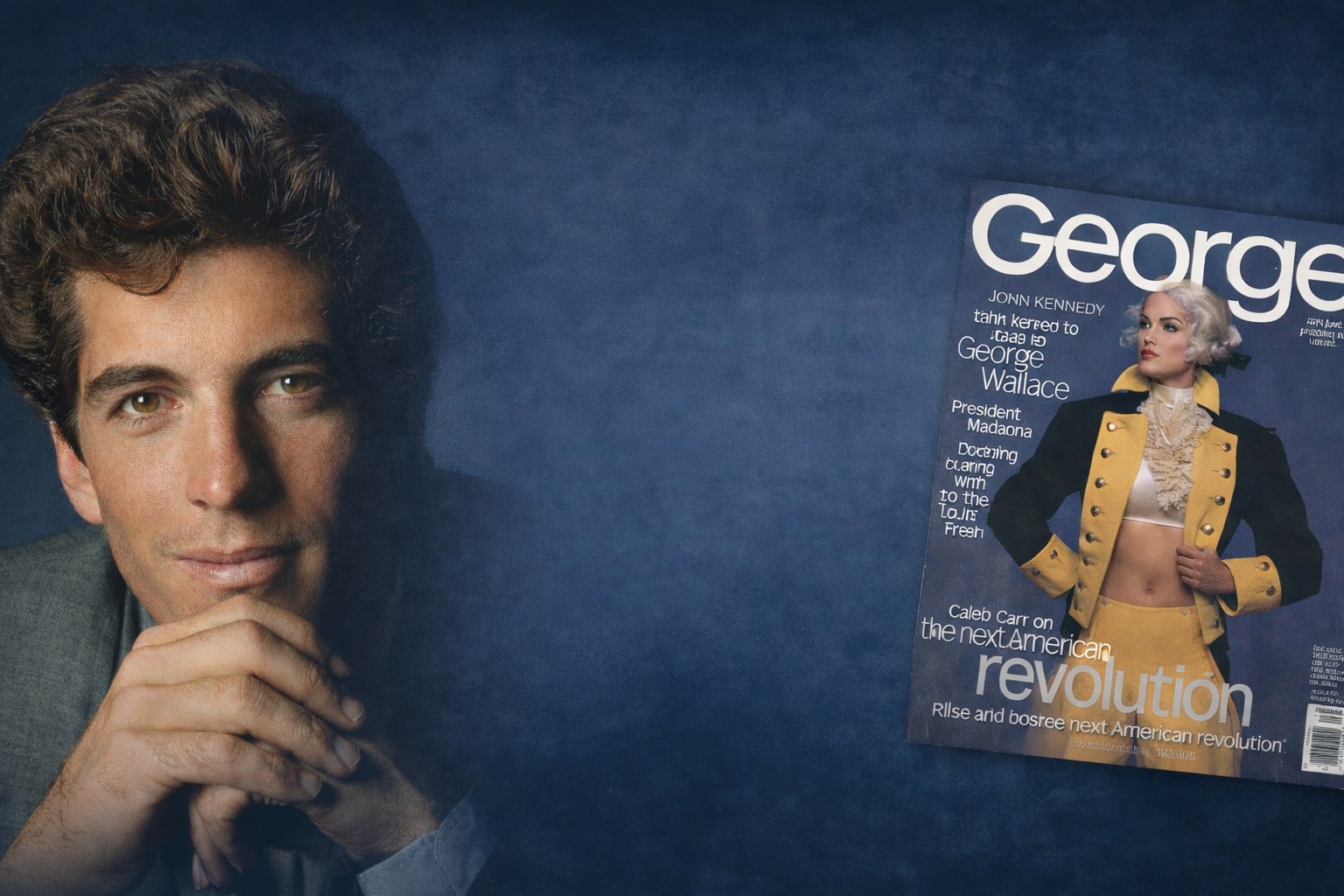
Image: Thomas
Remembering John F. Kennedy Jr., George Magazine, and the Moment Politics Became Cultural Again
In the mid-1990s, American politics had a branding problem.
Washington felt distant. Congressional battles appeared procedural and dull to younger Americans. Political journalism was respected, but rarely interesting to readers outside policy circles.
Into that moment stepped John F. Kennedy Jr., who believed politics could be serious without being joyless.
His answer was a magazine with an improbable idea: Make politics part of popular culture.
The result was George Magazine.
When Politics Entered the Cultural Conversation
Launched in 1995, George combined:
Political journalism.
Celebrity culture.
Visual storytelling.
Long-form political interviews.
It did something Washington media had rarely attempted before: It treated politics as a national cultural conversation, not merely an institutional one.
A famous early cover – the first cover in fact – featured Cindy Crawford dressed as George Washington.
Inside were interviews with world leaders, cultural figures, and political thinkers.
The message was simple: Politics matters, and it should engage the imagination.
For younger Americans coming of age in the 1990s, that was a refreshing departure from the increasingly cynical tone of late-Cold War political commentary.
A Magazine That Bridged Two Worlds
Kennedy’s editorial instinct was rooted in an unusual personal position.
He was both:
The son of a political dynasty.
A member of a generation skeptical of political institutions.
That dual identity shaped George. The magazine avoided partisan advocacy and instead focused on political ideas, leadership profiles, and generational questions about civic life. It brought figures from politics, culture, and media into the same pages.
In doing so, Kennedy anticipated something that would later dominate the 21st-century information environment: Politics as storytelling.
The Generation X Civic Moment
For many Generation X readers, George represented something rare in the 1990s media landscape: A publication that treated politics with style rather than cynicism.
At a time when public trust in government was declining after the Cold War and the Watergate era, Kennedy’s project suggested that civic engagement could remain intellectually and culturally vibrant.
The magazine did not try to replace traditional political journalism.
Instead, it complemented it, translating the world of policy and leadership into a language accessible to younger Americans.
In that sense, Kennedy was less a political publisher than a civic translator.
The Cultural Memory
Interest in Kennedy’s life has returned in recent years with the release of American Love Story, the FX and Hulu streaming series from Ryan Murphy that explores the story of John F. Kennedy Jr. and his wife, Carolyn Bessette.
While the series primarily focuses on the couple’s personal relationship and cultural influence, it inevitably draws renewed attention to Kennedy’s media experiment.
For those who remember the 1990s magazine landscape, George was more than a novelty. It was an early attempt to answer a question that still confronts political media today: How do you make democratic life compelling to citizens who did not grow up inside political institutions?
Where Thomas Mediazine Differs
Projects like George and Thomas share a common premise: Politics deserves thoughtful storytelling. But the approaches differ in important ways.
Where George often approached politics through the lens of celebrity culture and visual symbolism, Thomas focuses more directly on constitutional questions, institutional process, and the architecture of American governance.
The goal is not simply to make politics engaging, but to illuminate the structural ideas that sustain the republic.
If Kennedy helped make politics culturally interesting again, projects like Thomas attempt to make its institutional foundations – its constitutional principles – understandable.
Both serve a civic ideal.
A Path That Made Others Possible
John F. Kennedy Jr.’s life, like his father's before him, was cut tragically short. Yet the idea behind George endures.
Today’s political media environment – podcasts, video explainers, digital magazines, and narrative journalism – reflects the same instinct Kennedy pursued, knowing that politics can be explored through creativity as well as analysis.
For younger audiences, especially, engagement often begins with storytelling.
Kennedy understood that earlier than most.
A Respectful Legacy
It would be easy, in hindsight, to view George as a cultural artifact of the 1990s.
But its deeper contribution was philosophical.
It challenged the assumption that politics must be dry to be serious.
It suggested instead that democracy benefits citizens when they find public life interesting enough to pay attention.
That insight remains relevant today.
Projects like Thomas stand on different editorial ground, focused more on constitutional analysis than cultural politics. But they share a quiet debt to the experiment Kennedy launched three decades ago.
JFK Jr helped reopen the door to political storytelling.
The rest of us are still walking through it.