Chronic Politicitis
The National Disease Washington Refuses to Cure - Why America Keeps Treating Symptoms Instead of Solving Structural Problems
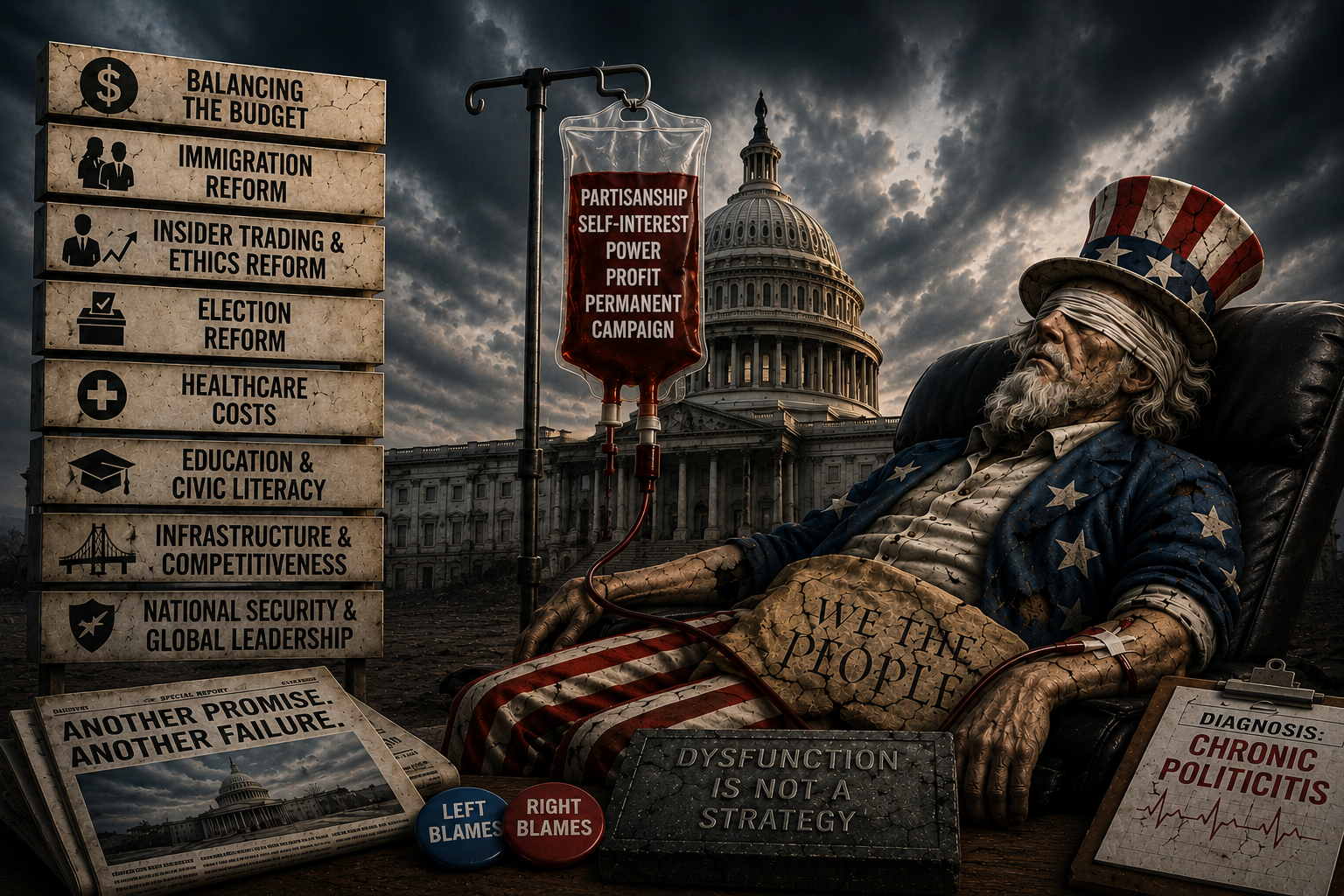
Image: Cannon & Caius generated with AI
America does not merely face political disagreements. America is increasingly suffering from Chronic Politicitis.
Chronic Politicitis is a persistent national condition in which major problems are endlessly debated, politically weaponized, emotionally exploited, and rarely solved structurally.
Both major parties campaign aggressively on these issues. Both blame one another constantly. Yet decade after decade, many of the same crises remain unresolved:
Rising national debt.
Immigration dysfunction.
Healthcare instability.
Insider political privilege.
Election distrust.
Infrastructure weakness.
Educational decline.
Collapsing civic trust itself.
Americans increasingly ask a reasonable question. If these issues are so urgent every election cycle, why do they remain unresolved generation after generation?
The answer may be uncomfortable. Because for many political actors, permanent problems generate permanent political power.
The National Debt: America’s Permanent Bipartisan Avoidance Strategy
The federal debt now operates less like a warning sign and more like background noise
Both parties publicly express concern. Both parties also repeatedly expand deficits when politically convenient.
Republicans often cut taxes without equivalent spending reductions. Democrats often expand programs without equivalent long-term fiscal restraint.
The result is exploding debt service, growing intergenerational burden, weakened fiscal flexibility, and increasing dependence upon borrowed governance.
Yet serious long-term budget reform rarely occurs because entitlement reform is politically dangerous, tax reform is politically dangerous, spending restraint is politically dangerous, and politicians increasingly prioritize election cycles over generational stewardship.
Immigration: Permanent Crisis as Political Fuel
Immigration may be the clearest example of Chronic Politicitis.
For decades, border security has remained inconsistent, visa systems have remained outdated, labor realities have remained unresolved, asylum systems have remained overwhelmed, and citizenship reform has remained politically radioactive.
Both parties accuse the other of extremism. Both parties also benefit politically from preserving the issue's emotional resonance.
Republicans frequently emphasize border security, sovereignty, and enforcement. Democrats frequently emphasize humanitarian concerns, compassion, and inclusion.
But comprehensive reform repeatedly collapses.
Why?
Because solving the issue risks eliminating one of Washington’s most powerful tools for emotional mobilization.
Insider Trading and Political Privilege
Perhaps nothing fuels public cynicism more than the perception that elected officials operate under a different ethical system than ordinary Americans.
Members of Congress routinely possess market-moving information, regulatory knowledge, and legislative insight unavailable to the public.
Yet meaningful restrictions on congressional trading repeatedly stall.
Why?
Because reform would require politicians to limit their own advantages.
This issue transcends parties.
Americans increasingly view Washington as a political investment club with constitutional branding.
That perception is devastating for institutional trust.
Election Reform and the Collapse of Confidence
The United States still lacks broad national confidence regarding election systems.
Different states use different standards, timelines, verification systems, and voting procedures.
The result is recurring distrust.
Some Americans fear suppression. Others fear insecurity.
Both concerns deserve a serious institutional response. Instead, election reform increasingly becomes tribal warfare, and every disputed election further weakens confidence in democratic legitimacy itself.
Healthcare Costs Continue Crushing Americans
Despite decades of promises, healthcare remains extraordinarily expensive, prescription costs remain volatile, insurance complexity remains overwhelming, and medical debt continues to burden millions.
Both parties have repeatedly campaigned on reform.
The system now often appears to be optimized for bureaucracy, lobbying, and institutional preservation rather than for patient simplicity.
Americans increasingly feel overcharged, overinsured, and underserved simultaneously.
Education and Civic Literacy Continue to Weaken
America’s educational systems increasingly struggle with affordability, uneven quality, politicization, declining civic literacy, and growing public distrust.
Many younger Americans now graduate with debt, confusion, and a limited understanding of constitutional government itself.
That creates long-term democratic risk.
A republic cannot function well if citizens distrust institutions but also do not understand how those institutions work.
Infrastructure and National Competence
Americans increasingly notice a visible national decline, including aging transportation systems, vulnerable power grids, gaps in digital infrastructure, housing shortages, and permitting paralysis.
The deeper issue is psychological.
Citizens increasingly question whether America still possesses institutional competence.
That matters enormously.
Strong nations project confidence partly through visible functionality.
Why Chronic Politicitis Persists
The uncomfortable truth is that modern political incentives often reward escalation over resolution, outrage over reform, and tribal loyalty over compromise.
Permanent crisis has become politically profitable.
Media ecosystems benefit. Fundraising benefit. Political consultants benefit. Outrage algorithms benefit.
But constitutional self-government gradually weakens amid permanent dysfunctions.
The Founders Would Recognize the Warning Signs
The founders feared faction intensely.
But they also feared corruption, public cynicism, and civic decay.
Madison warned repeatedly that republics weaken when faction overwhelms institutional balance.
Jefferson feared elite political detachment from ordinary citizens.
Hamilton feared instability and institutional weakness.
Read Our Hypothetical Publius Debates @ 250 For More Perspective From America’s Founders
Modern America increasingly exhibits all three concerns simultaneously.
So, What Is the Cure?
No single president can solve Chronic Politicitis alone, but several principles matter:
Institutional transparency.
Serious bipartisan negotiation.
Ethical accountability.
Long-term fiscal discipline.
Constitutional literacy.
Election legitimacy reform.
Reduced political tribalism.
Stronger civic expectations of leadership.
Most importantly, citizens themselves must stop rewarding performative dysfunction because politics ultimately reflects culture.
“When a republic becomes better at politicizing problems than solving them, dysfunction eventually becomes part of the governing structure itself.”
The Thomas Take
At Thomas, we believe the greatest danger facing America may not be one specific crisis. It may be the normalization of the unresolved crisis itself.
A republic cannot remain permanently healthy if every problem becomes tribal, every reform becomes impossible, and every election becomes emotional warfare.
The founders designed constitutional government to resolve conflict through institutions. Do not preserve dysfunction indefinitely for political advantage.
America does not merely need new slogans. It needs the political courage to cure Chronic Politicitis itself finally.