When Congress Heard History
The Best State of the Union and Joint Addresses of the 20th and 21st Centuries
Image: The Mirror
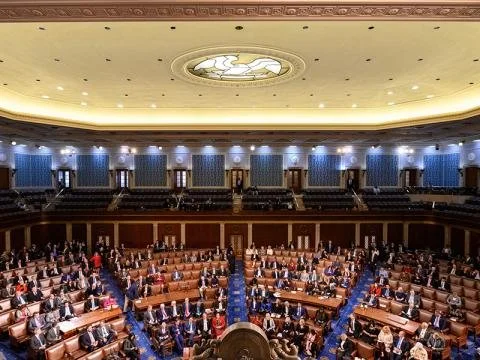
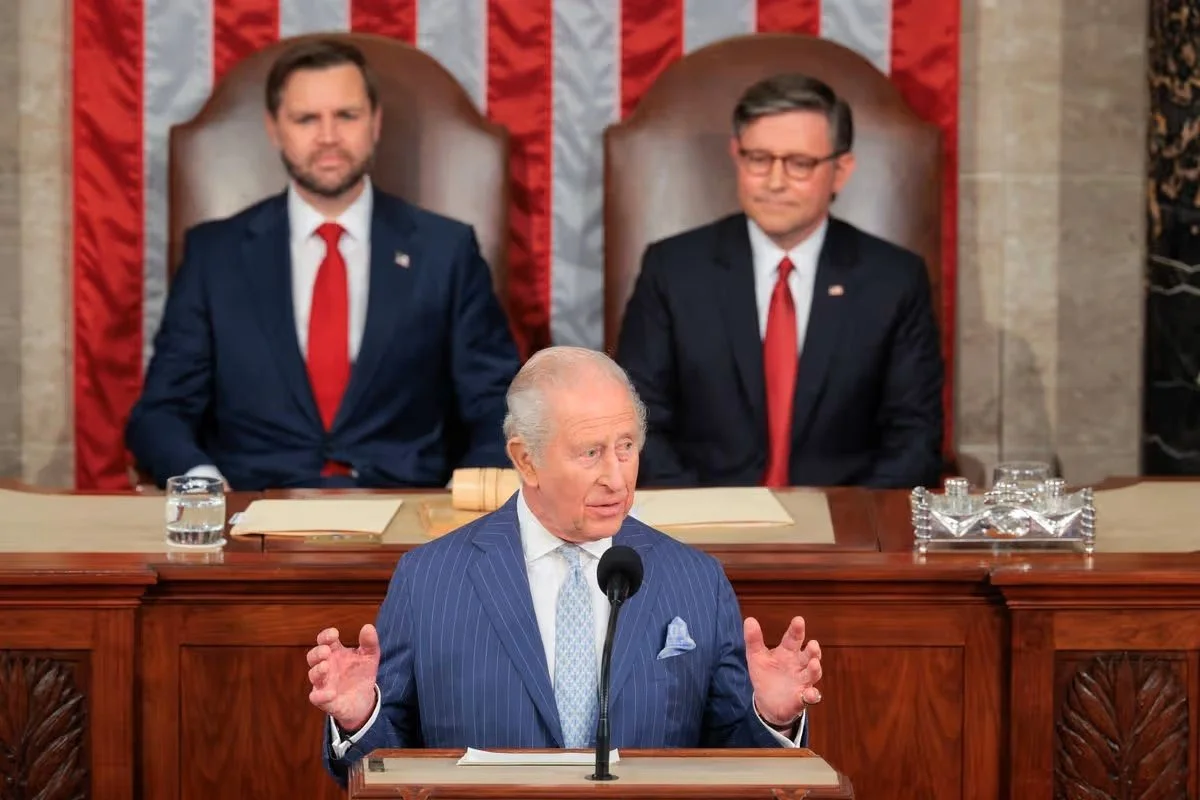
King Charles III’s address to Congress this week was remarkable because it reminded Americans of something often forgotten in our own political age: a speech before Congress can still rise above performance and become civic instruction.
The King’s remarks tied the U.S. – U.K. relationship to shared democratic values, NATO, Ukraine, AUKUS, America’s 250th anniversary, and the fragility of democratic order in a dangerous world. He followed the precedent set by Queen Elizabeth II in 1991, when she because the first British monarch to address Congress.
That raises a worthwhile Thomas question. Which State of the Union and joint-session addresses have made lasting impact on American politics?
Here are some of the best – not because they were theatrical, but because they gave Congress, the country, and sometimes the world a framework for understanding a decisive moment.
Franklin D. Roosevelt, 1941 – The Four Freedoms
FDR’s 1941 State of the Union was one of the most consequential presidential addresses ever delivered before Congress. Before America had entered World War II, Roosevelt framed the conflict not merely as a geopolitical contest but as a defense of universal freedom: freedom of speech, freedom of worship, freedom from want, and freedom from fear. The FDR Library in Hyde Park, New York, notes that these freedoms later symbolized America’s war aims. Why it endures: It transformed foreign policy into moral purpose.
Winston Churchill, 1941 – The Alliance Finds Its Voice
Churchill’s December 26, 1941, address to Congress came less than three weeks after Pearl Harbor. The Senate Historical Office described the packed chamber of lawmakers, cabinet members, and justices assembled to hear Britain’s wartime prime minister. Why it endures: It made the Anglo-American alliance feel inevitable, personal, and civilizational.
Harry Truman, 1947 – The Truman Doctrine
Truman’s 1947 address to Congress helped define the Cold War. The State Department described the Truman Doctrine as a reorientation of U.S. foreign policy away from withdrawal and toward political, military, and economic assistance to democratic nations threatened by authoritarian forces. Why it endures: It established the framework for containment and American global leadership.
John F. Kennedy, 1961 – Urgent National Needs
Kennedy’s May 25, 1961, address before a joint session gave America one of its clearest national missions: landing a man on the moon and returning him safely to Earth before the decade was out. NASA identifies this speech as the moment Kennedy committed the nation to that goal. Why it endures: It converted national insecurity into national ambition.
Lyndon Johnson, 1964 – The War on Poverty
Johnson’s 1964 State of the Union declared an “unconditional war on poverty in America.” Brookings identifies this as one of the sublime moments in State of the Union history, while American Archive notes that Johnson used the speech to lay out a broad legislative vision for fighting poverty. Why it endures: It turned domestic hardship into a national legislative campaign.
Anwar Sadat, 1975 and 1980 – Peace as Strategy and Risk
Egypt’s president Sadat addressed a joint meeting of Congress in 1975 and again in 1980 emphasizing diplomacy over perpetual conflict, partnership with the United States, and a pathway toward Arab-Israeli peace. Why it endures: Sadat’s appearances helped normalize the idea that a former adversary could seek strategic peace through U.S. partnership. It foreshadowed the Camp David Accords in 1978 and illustrated again in 1980 how a congressional address can redefine the realm of the possible, even at great personal risk. President Sadat was assassinated in 1981.
Ronald Reagan, 1981 – Resilience as Leadership
Ronald Reagan addressed a joint session on April 28, 1981, just weeks after surviving an assassination attempt. What made it exceptional wasn’t policy novelty. It was tone under pressure, composure without bravado, humor without trivializing the moment, and a pivot from personal ordeal to national purpose. Why it endures: Reagan’s speech is a model of restoring public confidence after a tremendously unnerving national trauma. Reagan used the chamber to stead the country and refocus it on recovery and shared effort, an archetype of presidential resilience.
Nelson Mandela, 1990 – The Moral Authority of Freedom
Mandela addressed Congress shortly after his release from prison, appealing for continued support for a multiracial democracy in South Africa. American Archive describes his message as a call for sanctions to remain until fundamental democratic change was achieved. Why it endures: It brought the moral force of the anti-apartheid struggle directly into the American legislative chamber.
Queen Elizabeth II, 1991 – Democracy by Consensus
Queen Elizabeth’s 191 address came at the end of the Cold War and after the Gulf War. She emphasized shared democratic values, the rule of law, individual freedoms, and Lincoln’s ideal of government “of the people, by the people, for the people.” Why it endures: It reminded Congress that power through force is not enough; legitimacy rests on law, consent, and democratic restraint.
Bill Clinton, 1997 and 2000 – Prosperity and Fiscal Responsibility
Clinton’s 1997 State of the Union urged Congress to make history by balancing the budget, while his 2000 address opened with a striking claim: America was enjoying unusual prosperity, social progress, and few external threats. Why it endures: These speeches captured a rare moment when economic growth, deficit reduction, and political confidence aligned.
George W. Bush, 2001 – Freedom at War with Fear
Bush’s September 20, 2001, address after the 9/11 attacks was not a State of the Union, but it was one of the most important joint-session speeches of the modern era. The White House archive records his framing: America had been “awakened to danger” and called to defend freedom. Why it endures: It gave Americans a language of resolve after national trauma, though the policy consequences that followed remain deeply debated.
Pope Francis, 2015 – The Common Good Before Congress
Pope Francis’s 2015 address was historic as the firsts papal speech to a joint meeting of Congress. The Vatican’s official record presents it as an appeal to the common good, human dignity, and moral responsibility in public life. Why it endures: It brough moral seriousness into a chamber often dominated by partisan calculation.
Volodymyr Zelenskyy, 2022 – Democracy Under Fire
Zelenskyy’s 2022 address to Congress occurred while Ukraine was under full-scale Russian invasion. His appeal framed Ukraine’s defense as part of a broader struggle for freedom and justice, speaking directly to Americans across states, cities, and communities. Why it endures: It turned a foreign war into a test of democratic solidarity.
King Charles III, 2026 – The Alliance at 250
King Charles’s address belongs in this conversation because it came at a symbolic moment: America’s 250th anniversary and a period of global instability. AP reports that he invoked shared democratic heritage, the rule of law, NATO, AUKUS, Ukraine, climate stewardship, technology, and the long evolution of the U.S.-U.K. partnership. Why it may endure: It reminded Congress that alliances are not ceremonial ornaments. They are strategic and moral commitments that must be renewed.
The Thomas Take
The best addresses to Congress share five qualities. They meet the moment. They define the stakes. They offer moral clarity. They connect policy to national purpose. And they leave behind language that outlasts the news cycle.
That is why the great addresses endure.
They do not merely speak to Congress. They speak through Congress to the republic itself.